Progress Over Perfection: Why Done Is Better Than Perfect

Let’s be honest — perfection is exhausting. But when you choose progress over perfection, everything changes. You move faster, smarter, and with more peace.

The pressure to be flawless shows up in our work, our homes, and our goals. But striving for perfection can hold us back.

You’ve likely felt it: the need to do everything just right.
To get 100%, not 91%.
To redo something over and over, even when it’s already good enough.

But here’s the truth:
Progress over perfection isn’t settling.
It’s strategy.

Progress Over Perfection vs. the Pressure to Be Perfect

I once watched a child chase straight A’s with tunnel vision.

She studied constantly, driven by the belief that anything less than 100% wasn’t good enough.
She was brilliant — but exhausted.

Eventually, after honest conversations, she realized something powerful:
An A is still an A, whether it’s a 91% or a perfect score.

That shift freed her. She began focusing on classes where she could truly grow.
She stopped wasting time on chasing what wouldn’t move the needle.

That’s not quitting. That’s intelligence.

It’s what choosing progress over perfection looks like in real life.

Why Progress Over Perfection Wins Every Time

Perfection is paralyzing. Progress is powerful.

Here’s what happens when you let go of being flawless:

  • You move faster.
  • You make better decisions.
  • You stop overthinking and start executing.

When you choose progress over perfection:

You trade pressure for clarity.
Control for confidence.
Shame for momentum.

Are You Focused on the Right Things?

Take a pause and ask yourself:

  • What are you obsessing over that’s already “good enough”?
  • What goals have you stalled on because they’re not perfect?
  • Where can 80% effort give you 100% of the results?

If you’re honest, you’ll see it: some things aren’t worth perfecting.
They’re just worth finishing.

Progress Over Perfection in Action

Here’s a quick audit to get back in alignment:

  • ✅ What’s one task you’ve been over-perfecting? Let it go.
  • ✅ What’s one decision you’ve delayed? Make it today.
  • ✅ What’s one thing you can improve, not perfect? Do that instead.

Momentum beats mastery — especially in the beginning.

Redefining Success

Inspired by Más Que Dinero, success isn’t about being flawless.
It’s about being aligned. About knowing what really matters — and doing that well.

You don’t need to do it all. You need to do what matters.

That’s the shift we all need:
To stop chasing applause and start choosing what truly matters.


Next Steps: How to Embrace Progress Over Perfection

If you’re done letting perfection slow you down, here’s your next step.

🎯 Prioritize the progress that matters.

🎤 Talk to someone about the pressure you’ve been under.
Start with a coach, mentor, or even me.

💬 Reach out here
📍 Google Business Profile
📱 Instagram
💼 LinkedIn

Know someone stuck chasing perfect?
Share this with them. Remind them:

Done is better than perfect.
Progress is power.

Better Isn’t Always Best: How to Know What’s Right for You

There comes a point in life when experience becomes your sharpest filter. At 50, I’ve learned that better isn’t always best. Just because something feels improved doesn’t mean it’s right for you—or good for your future.

In the days of old Gran Colombia, a region that once included Venezuela, Colombia, and Ecuador, there was a well-known phrase:

“La ley se acata pero no se cumple.”
The law is obeyed, but not fulfilled.

People acknowledged the law but often ignored it. They heard it, but they did not live by it. Sometimes this was rebellion. Other times it was survival. In many cases, it was wisdom earned through experience.

I saw this firsthand in South America, where people would run red lights late at night. Not because they were reckless, but because stopping made them vulnerable to robbery or worse. In moments like that, strict obedience could cost you your safety. Context mattered.

This same principle applies far beyond laws.

A Real Story from Ecuador

I lived in Ecuador for a year as part of a study abroad program with students from Oregon. One student stood out. We’ll call her Julie. She was blonde, bubbly, and visibly different from most of the local population.

Julie met a local man who was charming, attentive, and charismatic. Before long, marriage was on the table.

I asked her why she felt so certain.

“He is so much better than my ex,” she said.

Her ex had been physically and verbally abusive. And that was the problem.

Pain had become her point of reference.

Better than your worst does not mean best for your future.

I shared my perspective carefully. I explained that comparing a new relationship to trauma sets the bar dangerously low. Julie deserved more than “not abusive.” She deserved what was right for her long-term growth.

In the end, she made her decision.

They married, moved back to the United States, had a child, and later divorced.

I’m not telling this story to say I was right. I’m sharing it because too often we confuse comfort for clarity and relief for alignment.

Why “Better Isn’t Always Best” in Everyday Life

We all do it.

We compare ourselves to the wealthier person.
There’s the new car, the vacation photos, the growing follower count.
What we don’t see is what’s behind the filter.

Some of the same influencers we admire are breaking down, going broke, or silently drowning in pressure. We see the success, not the sacrifice. The surface, not the cost.

But the truth is, better isn’t always best. Especially when the choice is based on shallow comparisons, past pain, or fear of being alone. We chase progress by looking backward, and that rarely leads to alignment. The appearance of improvement doesn’t guarantee the reality of it.

This is why filtering advice and measuring growth requires clarity—not comparison.

Advice Is Not Truth Until It Is Filtered

As a father, I give advice to my young adult children. I also understand that advice only works when it is chosen, not forced.

The same is true for all of us.

Advice must be filtered.

You must decide if what sounds better is actually right, because better isn’t always best, even when it’s popular advice. What feels good isn’t always what builds you. What feels familiar isn’t always what frees you.

Here’s how to filter what you hear:

  1. Does this advice align with your values, or someone else’s fears?
  2. Does it enrich your life, or simply sound comforting?
  3. Can you trace real results from this advice, or is it just theory?

Good advice is not always pleasant. But it is always constructive.

Your Challenge

Pause before your next decision.

Consider whether you’re choosing from your future or reacting to your past. Are you trying to impress—or to progress? And is the option in front of you truly right, or just better than something that once hurt you?

Better can still be wrong. It is just more comfortable.

Final Thought: Better Isn’t Always Best in the End

Success is not about choosing what looks better.
It is about choosing what is right for you and having the courage to live with that choice.

In the end, better isn’t always best. What matters is what aligns with your future, your values, and your long-term purpose. Choosing what feels familiar or looks safer can keep you trapped in the same cycles you’re trying to grow beyond.

Your life is not built through comparison.
It is built through conviction.

CALL TO ACTION

To explore more insights on growth, clarity, wealth, and legacy, or to discuss how these strategies apply to your life or business, contact Mark Pinilla directly.

🌐 MarkPinilla.com
📍 Google Business Page
📘 The 10 Disciplines
💼LinkedIn

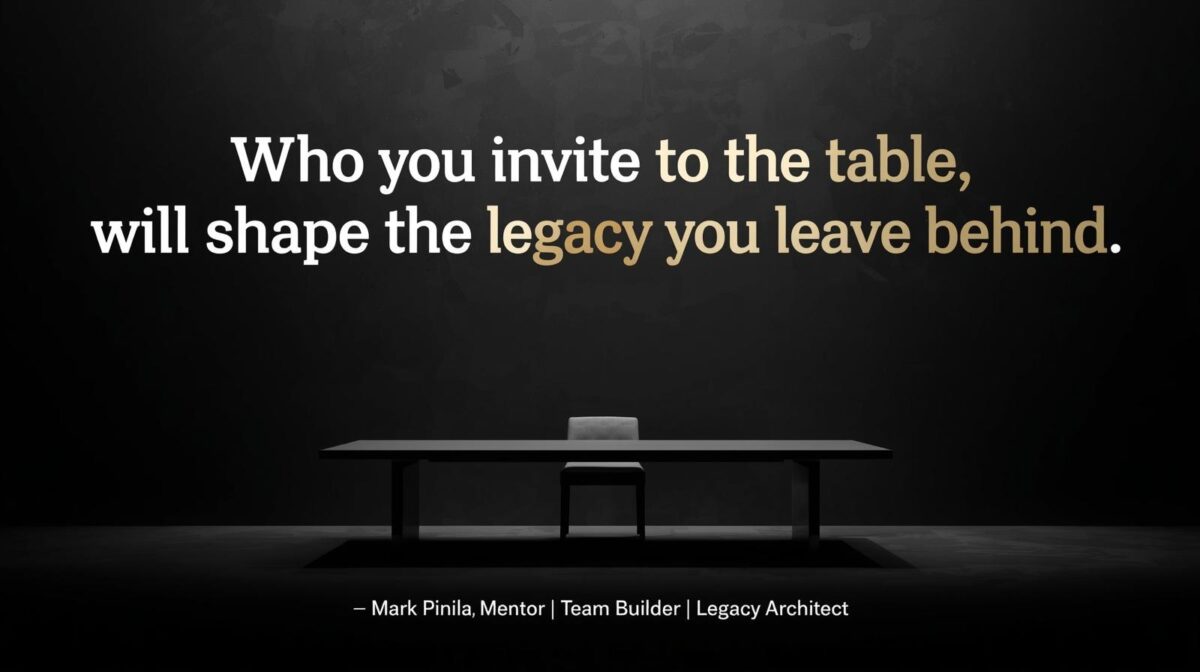
Who You Invite to the Table Shapes Your Legacy

I once wrote to a group of powerful women:

“You are not just building a life—you are building a legacy. And every legacy begins… at a table.”

That message still holds truth. It challenged readers to be intentional with their inner circle. To protect their energy. To choose people who stretch them, sharpen them, and dream even bigger alongside them.

It was a message of discernment—reminding us that not everyone deserves a seat.

But that was only one side of the equation.

Who’s Missing From the Table?

After you clear out distraction, drama, and misalignment, you face a deeper question: Who’s not at the table that should be?

Most of us gather people who reflect our comfort zone. We invite those who look like us, think like us, and affirm our ideas. While this feels natural, it limits our growth.

More importantly, it often causes us to miss the voices that would complete our vision.

Legacy Requires Both Energies

Let’s talk about what most tables are missing: balance.

In particular, we need to blend testosterone and estrogen—not just in gender, but in energy and approach.

Testosterone brings drive, direction, and execution. It accelerates movement.

Estrogen offers insight, emotional intelligence, and relational depth. It strengthens the foundation.

When testosterone dominates, things move fast—but may burn out. When estrogen stands alone, things feel grounded—but may hesitate to scale.

However, when these forces collaborate, we get both momentum and meaning. We create the chemistry that fuels legacy.

A Challenge to Men

If every voice at your table sounds like yours, you’re not leading a team—you’re stuck in an echo chamber.

And echo chambers don’t evolve. They collapse.

You need women at the table. Not to check a box, but because they bring depth you cannot create on your own. They elevate strategy with empathy. They turn movement into meaning.

Their presence isn’t a liability. It’s an advantage.

A Challenge to Women

You’ve already shown you can lead, execute, and rise.

Still, legacy isn’t built in isolation. Collaboration doesn’t diminish your brilliance—it amplifies it.

Yes, surround yourself with strong women. But also make space for men who see your strength, support your vision, and collaborate without controlling.

You’re not waiting for permission. But sometimes, you are waiting for alignment. And that requires courageous connection.

Reframing My Original Message

In my original writing, I said:

“No one comes to my table who does not add value to my life.”

That still stands.

This was always clear to me—but it wasn’t the point I was making then. That message was about protecting your space. This one is about expanding it.

Because value doesn’t always announce itself. Sometimes it walks in quietly. Sometimes it challenges you. And sometimes, it looks nothing like what you expected—but it changes everything.

A great team is made up of people who challenge, not just compliment.

They shift your perspective, question your assumptions, and make you better—not just busier.

Build With Intention, Not Comfort

You don’t rise to the level of your goals.
You fall to the level of your circle.

That’s why I intentionally include women at my table. Women who challenge with clarity, who sharpen with wisdom, who don’t just speak—but speak into what we’re building.

With them, it’s not about dominance or control. It’s about collaboration and creation.

Legacy isn’t built in echo chambers. It’s built in tension, trust, and truth.

Let’s Build Something That Lasts

If you’re ready to build that kind of table—not just to grow, but to grow with purpose—this is the work I do every day.

As a speaker, mentor, and trainer, I help individuals and organizations build teams rooted in values, vision, and legacy. Because success that stands alone fades. But success that lifts others with it? That becomes legacy.

Whether I’m coaching on intentional leadership, facilitating team development, or walking leaders through the NAHREP 10 Disciplines, my mission stays the same:

To help you build a life, a business, and a team that lasts.

You don’t need more noise.
You need alignment.
You need people who stretch your capacity, not drain it.
You need a circle that reflects your future—not your past.

That’s legacy work. And that’s what I do.

Learn more at www.markpinilla.com
Connect with me on LinkedIn: linkedin.com/in/markpinilla
Follow my journey on Instagram: @markpinilla

Let’s build the kind of team—and table—that shapes generations.

Success Through Curiosity and Lifelong Learning

To the One Who Wants to Win Without Burning Out

There’s something I wish I had learned earlier in life.

Success isn’t about being the smartest person in the room. It’s not about working more hours, earning more titles, or getting more likes.
It’s about being the one who never stops learning.

For years, I chased outcomes—results, recognition, revenue. But everything that truly moved my life forward started with something quieter: a question I couldn’t ignore, a book I couldn’t put down, a moment of curiosity that led to something bigger.

Curiosity has changed my life.
It’s the habit beneath every breakthrough. The instinct that pushes you to ask “Why?” when others are settling for “That’s just the way it is.”
It’s what makes you a better leader, a better partner, a better thinker.

Reading restructured my thinking.
It gave me access to mentors I’ve never met. It taught me how to communicate with clarity, how to see patterns in complexity, and how to trust my own voice. The right book at the right time is more than information—it’s a lifeline.

And lifelong learning? It’s the discipline that protects you from becoming obsolete.

If you’re serious about creating a life of depth and impact, here’s what I’ve learned:

1. Stay open, especially when you feel like shutting down.

Certainty is comforting—but curiosity leads to growth.

2. Read every day.

Even 10 minutes a day can rewire your thinking. Books are mentors that never miss a meeting.

3. Choose growth over ego.

Admit when you don’t know. That’s where transformation begins.

4. Teach what you learn.

It deepens your understanding and multiplies your impact.

5. Follow your questions.

Let your curiosity lead you. That’s where energy lives.

We live in a time where the world can change in a year. Whole industries shift. Algorithms evolve. Attention spans shrink.

But one thing will always compound: the person you’re becoming.

If you keep learning, keep reading, keep stretching—there is no version of the future where you lose.

This isn’t about ambition. It’s about alignment.
Align your actions with growth. Align your mindset with openness. Align your time with what really builds you.

You don’t need to be perfect. You just need to keep learning.

That’s the real edge.

Final Words from Mark Pinilla

Speaker | Certified Trainer | Legacy Builder

If you’re reading this and feeling a pull—a hunger for more—but you’re not sure where to begin, I want you to hear this clearly:

You don’t have to figure it out alone.

The difference between someone who drifts and someone who rises is often just one thing: a guide.

Someone who sees the path ahead. Who challenges you to level up, ask better questions, and align your habits with your highest values.

As a certified NAHREP 10 trainer and speaker, I’ve helped professionals, entrepreneurs, and legacy-minded individuals unlock the next chapter of their growth—financially, professionally, and personally.

If you’re serious about building a life that aligns with your purpose and potential, it may be time to invest in mentorship that moves you.


Ready to become who you were meant to be?

Let’s talk.

🔗 Schedule a discovery call
🔗 Visit markpinilla.com

#LifelongLearning #CuriosityDrivesSuccess #GrowthMindset #ReadToLead #SuccessThroughLearning #LeadershipDevelopment #MentorshipMatters #PersonalGrowth #HighPerformanceHabits #MarkPinilla #NAHREP10

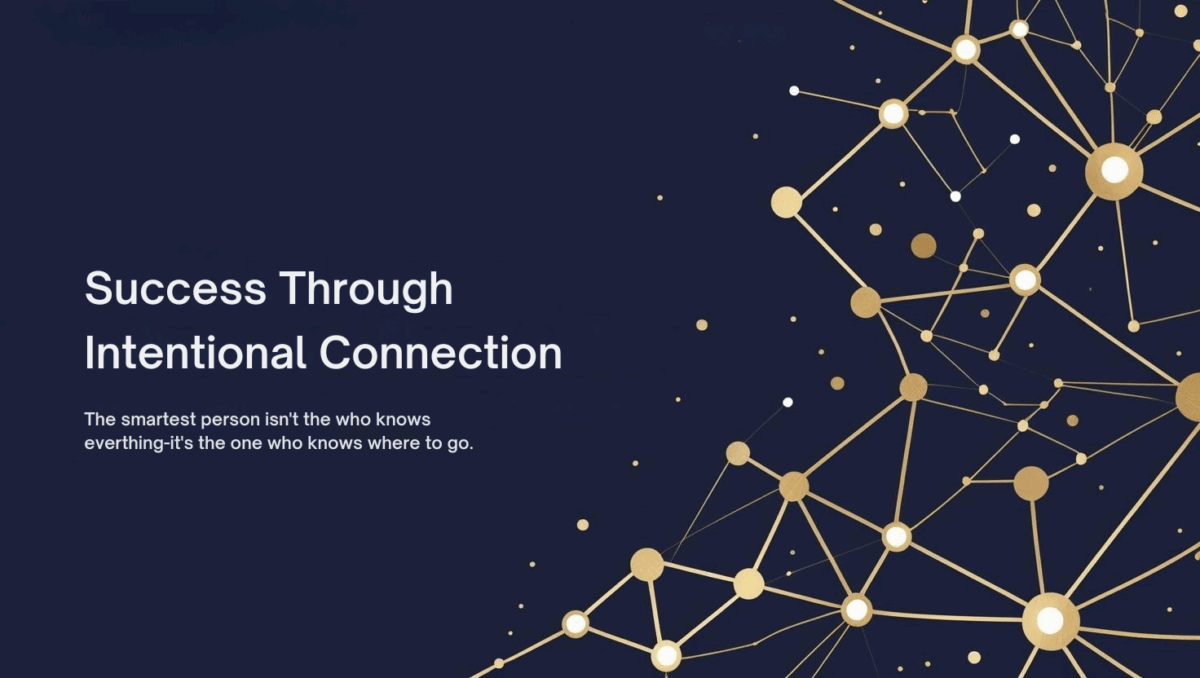
Success Through Intentional Connection

Why the smartest people don’t know everything—they know everyone.

There’s a myth we’ve been sold for far too long: that the smartest person in the room is the one who knows the most.

That’s false.

The smartest person in the room isn’t the encyclopedia. It’s the one who knows where to go, who to call, and how to connect people to what they need.

In today’s world, success doesn’t belong to know-it-alls. It belongs to connectors—the people who intentionally build bridges, learn from others, and lift everyone around them.

Intelligence Is No Longer What You Think It Is

You don’t need to know everything. It’s not possible.
The person who thrives in this economy is the one who knows where to find answers—and who they can trust to deliver them.

This kind of intelligence is social, emotional, and deeply human.

As my friend Nily Padron wisely says:

“You have to be intentional.”

That means showing up. Listening closely.
Remembering names. Asking questions that matter.
Caring about people’s dreams—even when there’s nothing in it for you.

That’s what builds authentic capital—not the transactional kind, but the kind that opens doors when you least expect it.

Be the Connector, Not the Competitor

Most people try to compete.
Few people try to connect.

But here’s the truth: matchmakers win—in business and in life.
Because when you become the person who helps others succeed, they remember. They refer. They return.

In the classic book The Go-Giver, Bob Burg writes:

“Your true worth is determined by how much more you give in value than you take in payment.”

When you help two people meet who were meant to meet, you’ve just created value without even sending an invoice.

Your Comfort Zone Is Not Your Calling

Connection requires one thing most people avoid: getting uncomfortable.

You’ll have to reach out. Go to events alone.
Start conversations that aren’t easy. Ask questions you don’t have the answer to.

You’ll have to become a student again—curious, humble, and open.

But this discomfort is where the magic is.

Put your hand on the pulse of what’s happening around you.
Pay attention to who’s building, who’s stuck, who’s hiring, who’s launching, who’s hurting.
And then ask: Who do I know that could help?

That’s the beginning of legacy work.

How to Build Intentional Relationships That Create Success

Here’s how to start becoming a connector today:

  1. Attend one new event this month. Even if it feels awkward.
  2. Ask better questions. Not “What do you do?” but “What’s exciting you lately?”
  3. Follow up meaningfully. A voice memo, a resource, a connection.
  4. Keep notes on people. Track what they care about.
  5. Look for “matches” everywhere. Every conversation is a potential connection.
  6. Give first. Always. Value leads. Ego follows.

The Mark of True Success

In a world of automation and AI, what can’t be replaced is human connection.
No algorithm can match your intuition.
No app can replicate the sincerity of a warm introduction.

If you want to be indispensable in your career, business, or community—become the person who makes others successful.

Introduce. Encourage. Serve. Listen. Match. Repeat.

Your network isn’t about who knows you.
It’s about who trusts you enough to say, “You need to talk to them.”

That’s how legacies are built.
That’s how doors open.
And that’s the mark of true success.


Ready to Build Deeper Connections That Lead to Real Success?

You don’t have to do it alone.

Whether you’re a rising leader, entrepreneur, or someone ready to live more intentionally—your next level will come through people, not just plans.

As a speaker, NAHREP 10 Certified Trainer, and mentor, I help individuals like you expand your influence by building the right relationships—with clarity, strategy, and purpose.

If you’re ready to become a connector, a giver, and a leader who elevates others while building your legacy—
Let’s connect.

🔗 Schedule a 1-on-1 discovery call
🔗 Follow or message me on LinkedIn
🔗 Follow on Instagram

#SuccessThroughConnection #IntentionalNetworking #RelationshipCapital #LeadershipDevelopment #ConnectorMindset #GoGiverMentality #LegacyBuilder #NAHREP #MarkPinilla #PurposeDrivenSuccess

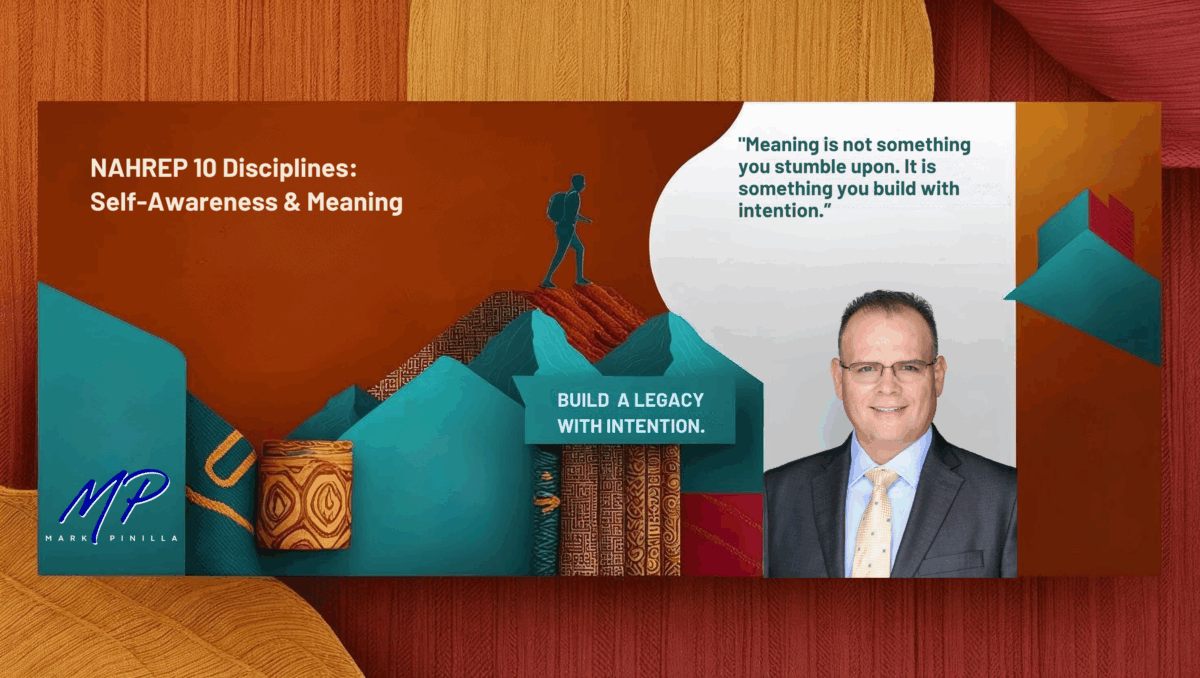
NAHREP 10 Disciplines: Self-Awareness & Meaning

In a time when achievement is often mistaken for fulfillment, the question of what gives life true meaning has never been more urgent. Many chase success but feel no satisfaction. They build wealth but lack peace. As someone who trains and coaches others using the NAHREP 10 Disciplines, I have seen firsthand that meaning is not found in accolades or approval. It is created through alignment, action, and accountability.

Meaning is not something you stumble upon. It is something you build with intention. And the foundation is discipline.

Simon Sinek teaches us to start with why. John Maxwell reminds us that leadership is influence. Brene Brown urges us to lead with vulnerability and integrity. These principles, echoed in the NAHREP 10 Disciplines, point us toward a powerful truth. When you align your daily actions with your highest values, your life becomes meaningful because it begins to matter to others.

As a NAHREP 10 Certified Trainer, my mission is to help professionals grow their impact by living with intention. Whether you are building a real estate business, creating financial freedom, or becoming a role model in your community, the lessons are the same. Be honest with yourself, stay disciplined in your habits, and lead with vision, as highlighted by the NAHREP 10 Disciplines.

Self-Awareness of your Financial Position

Every step toward lasting growth begins with one critical act: telling yourself the truth. Not sugarcoating. Not avoiding. Just getting real. This isn’t about guilt—it’s about ownership. Because when you clearly see where you stand, you finally have the power to change it.

One of the most transformational financial habits is knowing your net worth. It’s not just a number—it’s a mirror. It reflects how you’ve handled money, what habits you’ve built, and where your priorities lie. Tracking your net worth forces you to face the truth: what you own, what you owe, and what direction you’re actually heading in.

When you do the math, you stop guessing—and start growing. Because awareness leads to smarter decisions, and smarter decisions lead to financial freedom. That’s why this NAHREP 10 Discipline isn’t optional. It’s foundational within the NAHREP 10 Disciplines framework.

Mastery and Growth is a Core Value

A life without skill is a life without direction. As professionals, we must commit to being excellent at what we do. That means becoming a student of our craft. It means reading, training, practicing, and sharpening our thinking every single day.

Clarity in language and confidence in communication are more than soft skills. They are tools of influence. Whether in a client consultation or a family conversation, those who can speak clearly, listen actively, and write with purpose are those who lead with impact.

Being coachable is one of the most underrated disciplines. It is not about admitting weakness. It is about welcoming growth. A willingness to learn from others and evolve your mindset is how you stay relevant and resilient, as highlighted by NAHREP 10 Disciplines.

The Climb to Success: Discipline and the NAHREP Path to Impact

No worthwhile goal comes without resistance. The best leaders are not those who had it easy. They are those who chose to keep climbing when things got hard. If you want to be in the top 10 percent of your profession, you need to train for it like an athlete. Not just with more effort, but with more intention.

Success is not about working more hours. It is about doing the right work with the right mindset, for the right reasons. When your purpose is clear, your energy has direction. When your goals have depth, your discipline becomes sustainable. Aligning with the NAHREP 10 Disciplines makes this journey easier.

Civic Engagement and Advocating with Purpose

One of the most important but often overlooked aspects of building a meaningful life is the ability to impact change beyond your immediate circle. True leadership includes understanding how laws, policies, and government systems affect your business, your community, and future generations.

Being politically savvy means staying informed about public policy, engaging with your local representatives, and using your voice to advocate for the interests of underserved communities. It is not about partisanship or political theater. It is about responsible citizenship and strategic involvement in the systems that shape opportunity.

The NAHREP 10 Disciplines challenge us to use our influence not just for profit, but for progress. Whether you are supporting housing legislation, advocating for fair lending, or encouraging civic participation, your engagement matters. Change does not happen by chance. It happens when prepared leaders show up.

Call to Action

Now is the time to begin. Whether you are reflecting on your finances, your leadership, or your community impact, the shift starts with one decision—to become more intentional, more informed, and more aligned. You have the power to begin that change today.

If you are ready to lead a life that is not just successful but significant, reach out. I would be honored to support your growth, your business, and your role in creating generational wealth within your community. Whether through a strategy session, a training workshop, or simply a meaningful conversation, let’s move forward together.

Contact Mark Pinilla to explore how the NAHREP 10 Disciplines can help you grow, give back, and lead with impact.

#LiveWithPurpose #MeaningfulLeadership #NAHREP10 #LatinoLeadership #GenerationalWealth #BuildWithDiscipline #PolicyWithPurpose #EmpowerYAvanza #RealEstateImpact #CommunityDrivenSuccess #MarkPinilla #PurposeInAction #AdvocateForChange #LeadershipDevelopment #LegacyBuilders #HispanicWealthProject #NAHREP #NAHREPSouthFlorida

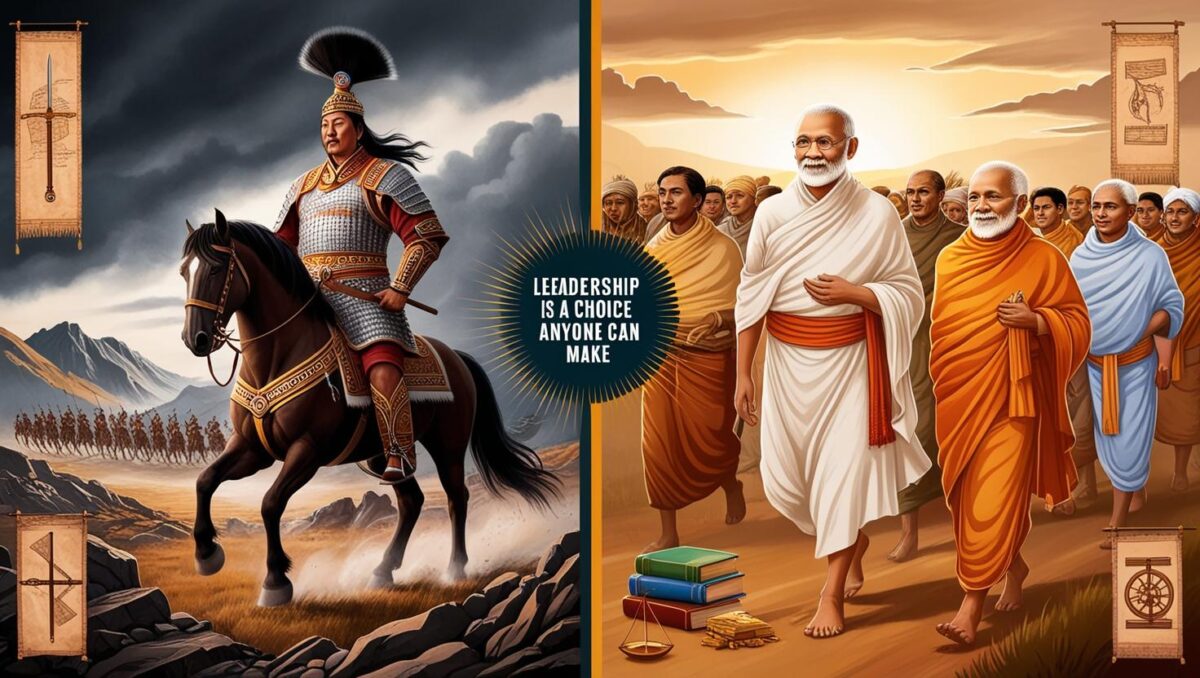
Leadership is a Choice Anyone Can Make

Leadership isn’t reserved for the privileged. Leadership is a choice anyone can make, and history shows that anyone—regardless of background—can inspire and lead with intention and relentless effort. Genghis Khan and Mahatma Gandhi, two leaders with opposing approaches, prove that leadership is about vision, dedication, and action.

Leadership stems from influence, vision, and hard work. It is neutral—capable of being harnessed for noble causes or ruthless ambition. True leadership requires more than just charisma; it demands effort, sacrifice, and perseverance.


Genghis Khan: The Ruthless Visionary

From humble beginnings on the harsh Mongolian steppes, Genghis Khan, born as Temujin, overcame betrayal, loss, and adversity. One story often told is how, after being captured and enslaved by a rival tribe, he escaped through sheer will and cleverness, returning stronger and more determined. His ability to turn setbacks into stepping stones defined his leadership. Genghis Khan implemented innovative military tactics, established efficient communication networks, and promoted meritocracy within his ranks. His empire thrived on discipline and loyalty, values he instilled through both fear and reward.

Key Lessons from Genghis Khan:

  • Strategic Planning: Every move was calculated, every alliance purposeful.
  • Work Ethic: Relentless pursuit of his goals despite overwhelming odds.
  • Adaptability: Quickly adapting to new challenges and integrating diverse cultures into his empire.

Gandhi: The Peaceful Revolutionary

Mahatma Gandhi’s leadership emerged from a deep sense of justice and empathy. Born in British-ruled India, Gandhi faced discrimination firsthand, shaping his resolve to fight oppression through nonviolence. His leadership mirrored the principles in NAHREP Discipline #7, which emphasizes being politically savvy because public policy matters. Gandhi’s activism, much like this discipline, recognized that policies impact everyday lives, and his efforts aimed at influencing public policy for justice and equality.

Key Lessons from Gandhi:

  • Moral Integrity: Staying true to his principles, regardless of the challenges.
  • Empowerment: Mobilizing ordinary people to take extraordinary actions.
  • Perseverance: Enduring hardship without compromising his mission.

The Psychology of Leadership Influence

Research shows that leaders who demonstrate confidence, empathy, and resilience are more likely to gain followers. Cognitive biases like the Halo Effect and Authority Bias play crucial roles. Genghis Khan inspired loyalty by rewarding talent and bravery regardless of background, while Gandhi’s emotional intelligence and storytelling during the Salt March united millions in peaceful protest. Insights from Harvard Business Review, American Psychological Association, and Psychology Today emphasize how emotional intelligence and storytelling enhance leadership influence by connecting with followers on a human level. Research shows that leaders who demonstrate confidence, empathy, and resilience are more likely to gain followers.


Leadership transcends time and culture. Whether through Genghis Khan’s strategic conquests or Gandhi’s peaceful protests, the essence of leadership remains the same—intention, hard work, and influence. Anyone can lead if they choose to, and history is proof of that.

Take your first step towards leadership today. Reach out to Mark Pinilla to explore how you can make a difference in your community.

#Leadership #GenghisKhan #Gandhi #Inspiration #HardWork #Success #MarkPinilla

Legal Issues in Real Estate Leasing: Brokers Must Step Up

The Florida real estate industry has faced increasing legal scrutiny regarding how realtors draft lease agreements. Many brokers have encountered lawsuits, contract disputes, and regulatory violations due to improperly written leases. The issue isn’t just about paperwork—it’s about professionalism, accountability, and ensuring that clients are protected.

Common Legal Issues in Lease Drafting

  1. Unauthorized Practice of Law – Florida law prohibits realtors from drafting legal documents beyond pre-approved lease agreements. Realtors who overstep these boundaries expose themselves and their brokers to legal liability.
  2. Ambiguous or Incomplete Terms – Poorly written leases often fail to clearly define responsibilities for repairs, deposits, and lease durations, leading to tenant-landlord disputes.
  3. Failure to Adhere to State and Local Laws – Lease agreements must comply with Florida’s landlord-tenant statutes. Realtors unaware of these laws risk drafting unenforceable contracts.
  4. Misrepresentation and Fraud Risks – Some realtors inadvertently include misleading terms or fail to disclose critical details, resulting in lawsuits or complaints.

The Call for Greater Professionalism

The National Association of Hispanic Real Estate Professionals (NAHREP) emphasizes professionalism as a core value, specifically in Discipline #2: Be in the Top 10% of Your Profession Because Being Good is Not Good Enough. This discipline challenges realtors to go beyond the basics and master the legal and ethical aspects of their profession.

To meet this standard, brokers must:

  • Provide ongoing legal training to ensure realtors understand the boundaries of lease drafting.
  • Encourage the use of standard lease templates approved by the Florida Association of Realtors and legal professionals.
  • Promote collaboration with real estate attorneys for complex lease negotiations.
  • Hold realtors accountable for compliance to protect both clients and the brokerage firm.

How Mark Pinilla Can Help

Mark Pinilla is a top-producing property manager with Keyes Property Management and trainer with nearly 30 years of real estate and property management experience. He supports over 1,000 REALTORS® at The Keyes Company, providing expert guidance on lease agreements, landlord-tenant laws, and compliance best practices. Mark also offers a specialized course, Understanding the Florida Lease Agreement, helping agents enhance their leasing knowledge.

For expert guidance on lease compliance, contact Mark Pinilla today.

Call to Action: Raising the Bar in Real Estate

Real estate professionals must step up their game. Brokers should implement stricter training, compliance checks, and ethical standards to mitigate legal risks. The industry’s reputation—and clients’ trust—depends on a commitment to professionalism and continuous learning.

Are you ready to challenge your team to uphold higher standards? The future of Florida real estate depends on it.

#RealEstateLaw #FloridaRealtors #LeaseCompliance #NAHREP #ProfessionalismInRealEstate #BrokerEthics

Dan Nziniga – Living the NAHREP Discipline #10

Living the NAHREP 10 Disciplines
Dan Nziniga

Dan Nziniga

Dreamworks – Inspiration Community Owner & Leader Dan Nzinga is being recognized for living Discipline #10.

Blood Isn’t Always Thicker Than Water: The Power of Chosen Family

They say that blood is thicker than water, but sometimes, there is no blood bond around. As a college student studying abroad, I found myself in a foreign country with no family by my side. My host family, though not related by blood, welcomed me with open arms. Almost instantly, I became a brother and an uncle, embraced as one of their own. Now, more than thirty years later, I am still called “uncle” and “brother,” a testament to the deep, unbreakable bonds we forged.

This experience embodies NAHREP’s 10 Disciplines, specifically Discipline #10: Be Active in the Lives of Your Family and Children (Learn more), because Familia is central to who we are. But family is not always defined by genetics—it’s defined by love, support, and shared experiences.

I see the same spirit reflected in Dan Nzinga and the community he has built. Through 21-day challenges, weekly Zoom calls, and constant mentorship, Dan has created his own family of coaches, trainers, and leaders who support one another in their personal and professional growth. He doesn’t just teach—he cares, guides, and inspires. His leadership has cultivated a self-made family that rallies around him and uplifts those who follow his path.

Every day, Dan delivers a dose of positivity and growth, reminding us that our true family isn’t always the one we’re born into—it’s the one we choose, the one that chooses us, and the one that pushes us to become better versions of ourselves.

Well done, Dan! Keep inspiring and leading your extended family to greatness.

Connect with Dan Nzinga: LinkedIn

#ChosenFamily #SupportSystem #NAHREP #DanNzinga #FamilyMatters #Mentorship #Inspiration

Get Off Your Butt: Take Action for Personal Growth

Personal Development: A Choice, Not an Accident

Denis Waitley once said, “Personal development is the belief that you are worth the effort, time, and energy needed to develop yourself.” Personal development is not just a concept; it’s a call to take action for personal growth. The key word here is belief—but belief without action is meaningless.

Too many people get stuck in the trap of waiting for the perfect moment. Newsflash: there is no perfect moment. Success doesn’t come to those who hesitate. It comes to those who decide, commit, and execute.

Why People Fail at Personal Development

Let’s be real. Most people fail at personal growth not because they lack intelligence or resources, but because they don’t take action. They get trapped in these mindsets:

  • “I don’t have time.” (Reality: You make time for what matters.)
  • “I’m not ready yet.” (Reality: No one ever is.)
  • “I don’t know where to start.” (Reality: Just start anywhere.)

Denis Waitley’s approach to personal growth was simple: self-discipline and self-belief lead to success. He studied high achievers and found that they all had one thing in common—they took action despite fear.

The Science of Personal Growth

Your brain is wired to resist change. It seeks comfort and predictability. However, pushing beyond your comfort zone is where growth happens.

According to neuroscience:

  • The prefrontal cortex (your decision-making center) weakens when you avoid challenges.
  • The amygdala (your fear center) triggers when you step out of your comfort zone.
  • The more you push yourself, the stronger your neural pathways for confidence and resilience become.

Bottom line? Growth happens when you force yourself to do hard things.

How to Take Action Today

You don’t need a five-year plan. You need to start now. Here’s a simple formula inspired by Waitley:

1. Rewire Your Mindset for Personal Growth

Stop saying “I can’t” and start saying “How can I?” Your brain listens to your words. Choose them wisely.

2. Commit to Small, Daily Wins

Don’t aim for massive change overnight. Aim for 1% improvement daily.

  • Read 10 pages of a personal growth book.
  • Wake up 30 minutes earlier.
  • Exercise for 15 minutes.

3. Eliminate Excuses

Ask yourself: Would my future self thank me for this decision? If the answer is no, then stop making excuses.

4. Surround Yourself with Growth-Minded People

Jim Rohn famously said, “You are the average of the five people you spend the most time with.” Choose wisely.

5. Take Action Before You Feel Ready

Confidence comes from doing, not from waiting. Just start—your future self will thank you.

Your Call to Action: Do It NOW

You’ve read this far. Now, it’s time to act. Take one step toward your growth right now.

What will you do today that your future self will thank you for?

🚀 No more waiting. No more excuses. Your time is now. Do it now!

Contact Mark Pinilla to get on track today!

#PersonalDevelopment #SelfGrowth #TakeAction #NoExcuses #MindsetMatters #SuccessHabits #DenisWaitley #GrowthMindset #SelfImprovement