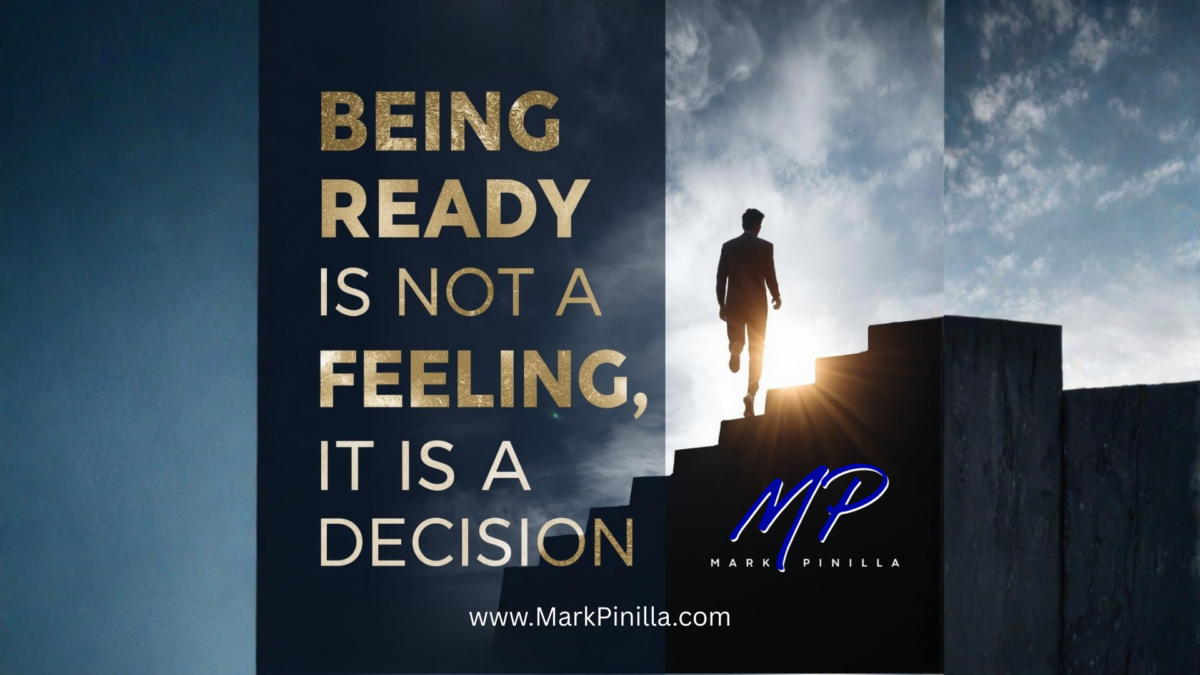
Being Ready Is Not a Feeling, It Is a Decision

Being ready is not a feeling. That is a lesson many of us learn the hard way. We tell ourselves we need to know more, feel more, see more, and experience more before we move. We think that once we have a little more information, a little more confidence, or a little more certainty, then we will finally be ready.

But somehow, it never feels like enough.

There is an internal battle in our heads that convinces us we cannot be successful until we feel ready. That is the trap. For many of us, readiness never shows up as a feeling. It shows up after a decision.

Why Being Ready Is Not a Feeling

Have you ever heard someone say, “You’re lucky”?

I understand what they mean. Sometimes the world defines luck as being in the right place at the right time. In my mind, that is lottery-ticket luck. It happens, but it is rare.

However, there is another kind of luck. It is the kind that shows up when preparation meets opportunity.

Is a race car driver lucky because he won? Or was he in the right place, at the right time, with the right training, the right repetition, and the right decision-making under pressure?

Put me in that race and I would be the slowest driver on the track.

Does a firefighter ever truly feel ready to run into a burning building, or do they make the decision to go in anyway? In my mind, most of us have it easy compared to that.

That is not luck. That is preparation.

What the STAR Personality Test Taught Me

About 25 years ago, I took a personality test called STAR, and it was one of the most impactful trainings I have ever taken. It helped me understand who I was, but just as importantly, it helped me understand who I could become.

STAR stands for:

S = Stability
T = Theory
A = Action
R = Relationship

I will not be able to do the full training justice here, but I hope I can at least help you understand these personality types.

An S is someone who likes order. They are organized and need things in place to feel like they can function. While that can be a strength, it can also slow them down. Sometimes the need for order keeps them from doing the very activities that would actually make them successful.

A T is what some might call the techy one, the analytical one, and the nerd all in one. They like to know why the world turns. They want information, stats, and numbers before making decisions. But the need to have all the information can also become their Achilles’ heel. This person often will not move forward until they feel they have all the information or all the training to make the right choice.

An A is a person who just does it. They do not always know how to do it, and yet they still try. Over and over until they get it. It does not matter how many mistakes they make, how much money they lose, or how uncomfortable it gets, they go after what they want.

An R is focused on relationships and how others feel, sometimes even in spite of their own feelings. They are cause-focused individuals. They care deeply. They are so giving that others may sometimes take advantage of them. Truly, they are the kind of person who would give you the shirt off their back.

While we all have varying degrees of each one, some are stronger than others. I also believe it is important that we work on strengthening the good aspects of each one.

My Strongest Traits Were T and R

At around 25 years old, my strongest traits were T and R. Funny enough, I know I still am. The difference now is that I have made it a point to strengthen the weaker traits too, especially the ability to act before I feel completely ready. Honestly, that growth has made a real difference in my life.

I say that because I am successful. I do very well, but I also know I could do so much more.

The most interesting part is that the A personality type often has an advantage when it comes to success, because action creates momentum.

Why?

Because of the ability to act without overthinking. To try things without knowing everything. To move forward without carrying so much concern about what others think.

That, to me, is one of the secret ingredients.

The A personality does not wait to feel ready. They make the decision to do it.

Being Ready Is Not a Feeling, It Is a Decision

So why is it so hard?

Because we are looking for the feeling to be right, when in reality, it does not matter nearly as much as we think it does. We are waiting for confidence, certainty, and comfort to show up first.

But most of the time, movement has to come first.

For me, one of the biggest struggles has been feeling like I am being pushy or getting into someone else’s business. Then I ask myself a harder question.

What if what I have is so important that it could truly change their life?

What if the difference I can make in their life could be exponential?

What if I stay quiet, and later I see that family member, friend, or potential client suffer, when I had an answer, a solution, or a path that could have helped them, and I never shared it?

How would I feel then?

That question changes everything.

Because sometimes what looks like being pushy is actually caring enough to speak up.

Sometimes what looks uncomfortable is actually necessary.

Sometimes what looks bold is exactly what love, service, and leadership require.

That is why this message matters so much to me:

Being ready is not a feeling. It is a decision.

You do not need to feel every emotion lining up perfectly before you begin. You do not need every answer before you take the first step. You do not need permission to move forward on the thing that has been sitting in your heart.

You need a decision.

Stop Waiting to Feel Ready and Start Moving

So what is today’s moral of the story? What do I want you to take home?

Stop waiting to feel ready, and start moving.

Make the call. Start the conversation. Share the value. Offer the help. Do the thing that has been pulling at your spirit.

If they are your friend or family, they will listen.

If they are not, show them value. Show them that you care.

Not too long ago, I wrote a legacy statement. This is my compass and my mission:

“My legacy will be that I served others so they could live a better quality of life and become better versions of themselves, financially, educationally, spiritually, and in their family lives. I hope to inspire them to serve in the same way.”

That is what I want my life to stand for.

So if you are in a rut, it is okay.

Find that person who is going to inspire you to do great things. Look for the person who is going to challenge you. Chase that dream and make it a reality.

Do not wait for the feeling.

Make the decision.

Because the people who change their lives are rarely the ones who felt the most ready.

They are the ones who decided to go anyway.

Make the Decision

At some point, we all have to stop waiting for the feeling and start making the decision.

So if you are ready to grow, to lead, to serve, and to build a better life for yourself and the people around you, connect with Mark Pinilla.

Because a better future does not begin when you feel ready. It begins when you decide.

Visit MarkPinilla.com to begin building your legacy:
👉 https://www.markpinilla.com

Follow Mark on Instagram for leadership insights and encouragement:
👉 https://www.instagram.com/markthespeaker

Connect professionally on LinkedIn:
👉 https://www.linkedin.com/in/markpinilla/

See what others are saying about Mark:
👉 https://share.google/M8EO56f4ZJTNVieuh

Follow Mark on Bluesky:
👉 https://bsky.app/profile/markpinilla.bsky.social

Quote & title inspired by Chicago Fire: “Being ready is not a feeling. It is a decision.”
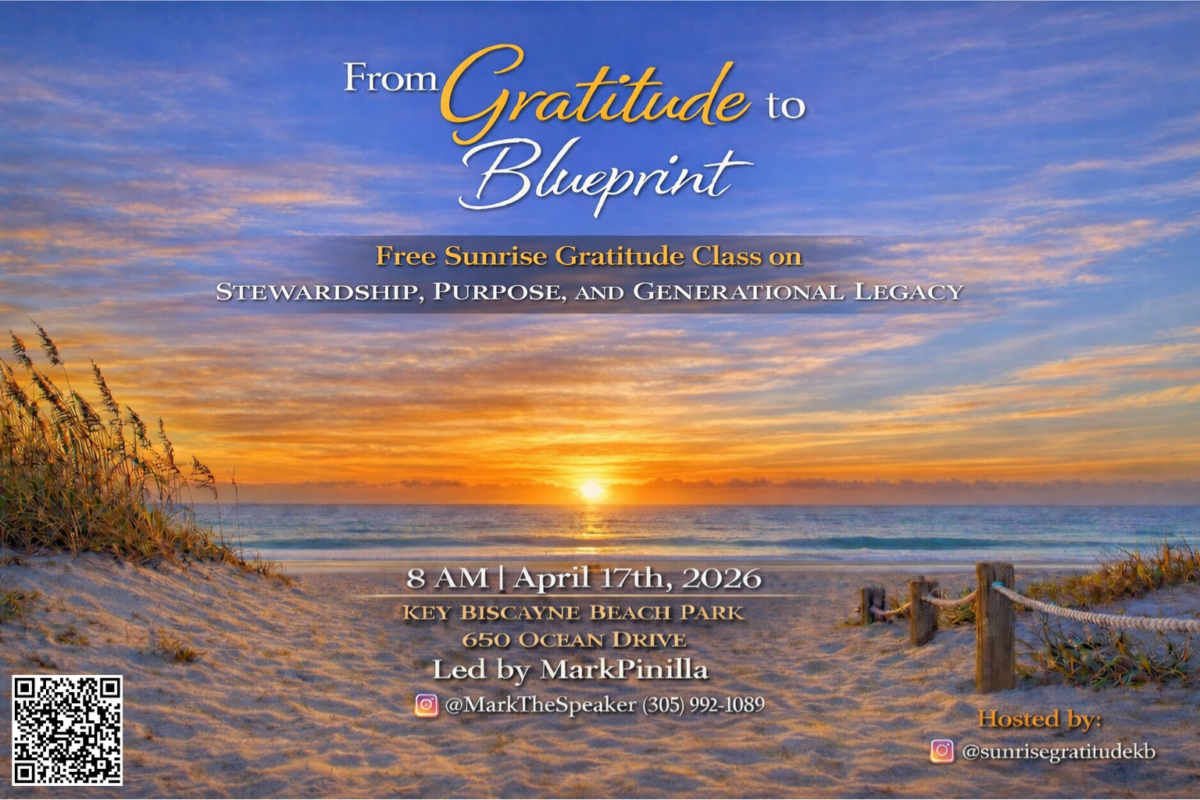
Gratitude to Blueprint: Purpose, Stewardship, Legacy

A Master Class on Stewardship, Purpose, and Generational Legacy

From Gratitude to Blueprint is master class that teaches how to honor the blessings we have received by becoming wise stewards of them. Through service, intentional planning, wise counsel, and legacy-building, participants will learn how to turn gratitude into meaningful action and create something that can be passed on financially, educationally, and spiritually.

This is a Free Event.

Bring towels, blankets, and/or chairs to sit on the beach. 

Follow Mark Pinilla on Instagram

Follow Sunrise Gratitude Key Biscayne on Instagram


Lead With Gratitude and Build Lasting Legacy

To lead with gratitude is not simply a mindset. It is a responsibility.

When you pause and reflect on your life, you realize something powerful. You did not build your success alone. Someone believed in you. Someone forgave you. Someone invested time, patience, and wisdom into you when you needed it most.

Because of that, you now carry a responsibility.

Gratitude is not passive. Gratitude demands action.

If someone loved you into who you are becoming, then you now have the opportunity to multiply that same love and leadership into the lives of others. When you lead with gratitude, you create influence that lasts. That is how you build lasting legacy.


Why You Must Lead With Gratitude

Leadership is not about position.
Leadership is about example.

When you choose to lead with gratitude, you:

  • Model character
  • Demonstrate emotional strength
  • Inspire resilience
  • Encourage growth in others

People are watching how you respond to pressure. They are watching how you treat others. They are watching how you handle challenges.

You may not realize it, but your life is always teaching.

The question is simple: What lesson are you modeling?

If you want to build lasting legacy, you must first lead with gratitude consistently and intentionally.


Keep Adding. Never Stop Growing.

I am often reminded of 2 Peter 1:5–8 (NIV), which you can read in full at BibleGateway:

It says:

“For this very reason, make every effort to add to your faith goodness; and to goodness, knowledge; and to knowledge, self-control; and to self-control, perseverance; and to perseverance, godliness; and to godliness, mutual affection; and to mutual affection, love. For if you possess these qualities in increasing measure, they will keep you from being ineffective and unproductive in your knowledge of our Lord Jesus Christ.”

What stands out is simple.

It never says stop.

It does not say add until life becomes difficult.
It does not say add until culture becomes unstable.
It does not say add until you feel discouraged.

It says add.

Keep growing.
Keep strengthening your character.
Keep increasing your capacity to love.

When you lead with gratitude, you continue adding to your life regardless of what the world subtracts.


Be Pillars in a Shifting World

We cannot allow ourselves to be discouraged by the world and its challenges.

The world does not need more critics. It needs pillars.

Pillars in our homes.
Pillars in our businesses.
Pillars in our communities.

When you lead with gratitude and live intentionally, you become steady in uncertain times. Your consistency becomes strength for others. Your character becomes stability for those you influence.

That is how you build lasting legacy.


Ready to Build Your Legacy?

Gratitude is not theory. Leadership is not accidental. Legacy is not automatic.

It is built.

If this message speaks to you and you are ready to grow intentionally, I invite you to connect with Mark Pinilla.

Visit MarkPinilla.com to begin building your legacy:
👉 https://www.markpinilla.com

Follow Mark on Instagram for leadership insights and encouragement:
👉 https://www.instagram.com/markthespeaker

Connect professionally on LinkedIn:
👉 https://www.linkedin.com/in/markpinilla/

See what others are saying about Mark:
👉 https://share.google/M8EO56f4ZJTNVieuh

The world does not need more critics.
It needs pillars.

Be steady.
Be grateful.
Be love in action.

Better Isn’t Always Best: How to Know What’s Right for You

There comes a point in life when experience becomes your sharpest filter. At 50, I’ve learned that better isn’t always best. Just because something feels improved doesn’t mean it’s right for you—or good for your future.

In the days of old Gran Colombia, a region that once included Venezuela, Colombia, and Ecuador, there was a well-known phrase:

“La ley se acata pero no se cumple.”
The law is obeyed, but not fulfilled.

People acknowledged the law but often ignored it. They heard it, but they did not live by it. Sometimes this was rebellion. Other times it was survival. In many cases, it was wisdom earned through experience.

I saw this firsthand in South America, where people would run red lights late at night. Not because they were reckless, but because stopping made them vulnerable to robbery or worse. In moments like that, strict obedience could cost you your safety. Context mattered.

This same principle applies far beyond laws.

A Real Story from Ecuador

I lived in Ecuador for a year as part of a study abroad program with students from Oregon. One student stood out. We’ll call her Julie. She was blonde, bubbly, and visibly different from most of the local population.

Julie met a local man who was charming, attentive, and charismatic. Before long, marriage was on the table.

I asked her why she felt so certain.

“He is so much better than my ex,” she said.

Her ex had been physically and verbally abusive. And that was the problem.

Pain had become her point of reference.

Better than your worst does not mean best for your future.

I shared my perspective carefully. I explained that comparing a new relationship to trauma sets the bar dangerously low. Julie deserved more than “not abusive.” She deserved what was right for her long-term growth.

In the end, she made her decision.

They married, moved back to the United States, had a child, and later divorced.

I’m not telling this story to say I was right. I’m sharing it because too often we confuse comfort for clarity and relief for alignment.

Why “Better Isn’t Always Best” in Everyday Life

We all do it.

We compare ourselves to the wealthier person.
There’s the new car, the vacation photos, the growing follower count.
What we don’t see is what’s behind the filter.

Some of the same influencers we admire are breaking down, going broke, or silently drowning in pressure. We see the success, not the sacrifice. The surface, not the cost.

But the truth is, better isn’t always best. Especially when the choice is based on shallow comparisons, past pain, or fear of being alone. We chase progress by looking backward, and that rarely leads to alignment. The appearance of improvement doesn’t guarantee the reality of it.

This is why filtering advice and measuring growth requires clarity—not comparison.

Advice Is Not Truth Until It Is Filtered

As a father, I give advice to my young adult children. I also understand that advice only works when it is chosen, not forced.

The same is true for all of us.

Advice must be filtered.

You must decide if what sounds better is actually right, because better isn’t always best, even when it’s popular advice. What feels good isn’t always what builds you. What feels familiar isn’t always what frees you.

Here’s how to filter what you hear:

  1. Does this advice align with your values, or someone else’s fears?
  2. Does it enrich your life, or simply sound comforting?
  3. Can you trace real results from this advice, or is it just theory?

Good advice is not always pleasant. But it is always constructive.

Your Challenge

Pause before your next decision.

Consider whether you’re choosing from your future or reacting to your past. Are you trying to impress—or to progress? And is the option in front of you truly right, or just better than something that once hurt you?

Better can still be wrong. It is just more comfortable.

Final Thought: Better Isn’t Always Best in the End

Success is not about choosing what looks better.
It is about choosing what is right for you and having the courage to live with that choice.

In the end, better isn’t always best. What matters is what aligns with your future, your values, and your long-term purpose. Choosing what feels familiar or looks safer can keep you trapped in the same cycles you’re trying to grow beyond.

Your life is not built through comparison.
It is built through conviction.

CALL TO ACTION

To explore more insights on growth, clarity, wealth, and legacy, or to discuss how these strategies apply to your life or business, contact Mark Pinilla directly.

🌐 MarkPinilla.com
📍 Google Business Page
📘 The 10 Disciplines
💼LinkedIn

Emotions Are Skills: Master the Feelings That Shape Your Life

Why Emotions Are Skills, Not Traits

Most people treat emotions like the weather. Something that “just happens.”

But emotions aren’t random. They’re not fixed. They’re not personality traits.

Emotions are skills.
You can learn them. Train them. Master them.

Anger, love, fear, joy—these aren’t forces outside you. They’re tools inside you. When you train them, they work for you. When you don’t, they control you.

The difference? Skill.

Emotional Intelligence: The Real Advantage

In today’s world, emotional intelligence (EQ) beats IQ almost every time.

Emotional intelligence isn’t just a “soft skill” — it’s a strategic advantage. Meta-analyses of dozens of studies show that emotional intelligence has a stronger impact on job performance than either IQ or personality traits. In fact, people with higher emotional intelligence tend to perform better, lead more effectively, and build stronger teams. One large-scale study published in Journal of Organizational Behavior found that emotional intelligence accounted for unique variance in performance outcomes, above and beyond cognitive ability or technical skill.

It’s also the #1 predictor of:

  • Job promotions
  • Conflict resolution skills
  • Leadership effectiveness
  • Relationship longevity

Think about it. In high-stress moments, the calmest person wins.
In teams, the most empathetic person connects.
In leadership, the most emotionally skilled person earns trust.

A Personal Story of Emotional Growth

I remember early in my marriage, when my emotional reactions did more damage than good. Raised voices, short tempers, poor control. That wasn’t strength—it was immaturity.

Later, I was presenting at a church camp. While speaking, a glass of water tipped and spilled right onto my laptop. I watched it fall in slow motion.

And yet—I stayed calm.

I instinctively grabbed the laptop, turned it upside down, and kept speaking. No panic. No blame. Just poise.

Same person. Different emotional skill set.

How to Build Emotional Mastery

Let’s get practical. Here are four simple ways to build emotional skills:

1. Name It to Train It

When a strong emotion hits, ask:

What is this? Anger? Anxiety? Shame? Jealousy?

Naming it gives you power over it. It moves you from reaction to reflection.

2. Separate Emotion from Event

Not everything you feel is your fault. One of the most powerful shifts I’ve made is this:

I stopped taking responsibility for what I didn’t cause.

That gives me space to respond—not react.

3. Train the Pause

Emotional mastery often lives in a 3-second pause.
Before you reply. Before you post. Before you yell.

Practice breathing, counting to three, and choosing your tone.

4. Sharpen the Blade

Like any skill, emotions get dull. You need to sharpen them through feedback, reflection, and intentional practice.

Ask:

  • What emotion keeps controlling me?
  • What emotion do I want to show more of—compassion, courage, patience?

That’s your edge.

From Reaction to Legacy

You are not your emotions. You are the trainer of your emotions.

So sharpen your edge. Like a blade, you cut cleaner when you’re sharp.

Whether you’re a father, friend, leader, or partner—mastering your emotions will change how people experience you.

That’s legacy.


Your Challenge Today

  • What emotion keeps hijacking your best moments?
  • What would it look like to train that emotion like a muscle?
  • What would change in your marriage, your leadership, your legacy?

Choose one emotion. Sharpen it. Train it. Own it.


Want Help? Let’s Talk.

If you’re ready to go from good to great emotionally—to lead with clarity, peace, and power—I’d love to help.

Contact Mark Pinilla for one-on-one coaching or team trainings in emotional intelligence, leadership, and legacy-building.

Follow Mark on Instagram: @MarkTheSpeaker

#EmotionalIntelligence, #EmotionalMastery, #SelfAwareness, #PersonalGrowth, and #MasterYourEmotions

You Can’t Control Everything, But You Can Control Your Response

Life has a way of humbling us. One moment, everything is going smoothly, and the next, you’re hit with an unexpected challenge—a job loss, a heartbreak, a health crisis. We scramble, trying to regain control, but here’s the truth: You don’t control the storm. You only control how you sail through it.

John C. Maxwell says, “Life is 10% what happens to you and 90% how you react to it.” Eric Thomas tells us that pain is temporary but quitting lasts forever. So, if we can’t dictate every outcome, how do we shift our energy toward winning despite the chaos?

1. Control Your Mindset

Your thoughts dictate your actions, and your actions shape your future. When you face obstacles, you have two choices: Let them defeat you or use them as fuel to push forward. Instead of saying, “Why me?” start asking, “What can I learn from this?” This mental shift transforms pain into power.

Exercise:

Every morning, practice gratitude. Write down three things you’re grateful for. This rewires your brain to focus on abundance instead of lack.

2. Adapt, Don’t Resist

Resistance leads to suffering. The more we fight what we can’t control, the more exhausted we become. Instead, embrace adaptability. Like water, flow around obstacles instead of smashing into them. Life doesn’t stop moving, and neither should you.

Action Step:

Identify one thing in your life you’ve been resisting and find a way to embrace it. Instead of fearing change, ask yourself, “How can this make me stronger?”

3. Channel Your Energy into What Matters

Worry drains energy. Fear paralyzes. Instead of obsessing over what you can’t change, shift your focus to things you can influence. Can’t control the economy? Master your financial discipline. Can’t control other people? Master your reactions. Your energy is a currency—spend it wisely.

Quick Hack:

List three things you can control today and take action on them. Small wins create unstoppable momentum.

4. Surround Yourself with Resilient People

Energy is contagious. If you surround yourself with complainers, you’ll become one. But if you align yourself with warriors—people who push forward despite adversity—you’ll rise with them.

Challenge:

Audit your circle. Who inspires you? Who drains you? Adjust accordingly. Choose to walk with winners.

5. Give More Than You Take

When life feels unfair, the best way to reclaim your power is by giving. Acts of kindness shift your focus from lack to abundance. Serve others, and you’ll find renewed purpose in your own struggles.

Mission:

Perform one selfless act today. Whether it’s a kind word, a donation, or a helping hand, put positive energy into the world.

Your Call to Action: Rise Up!

You weren’t made to break. Life is testing you not to destroy you, but to make you stronger. Refuse to be a victim. Choose to be a fighter. Embrace challenges, adapt, and thrive. Because at the end of the day, the ones who succeed aren’t the ones who control everything. They’re the ones who master themselves.

Are you ready to turn obstacles into opportunities? Start today. Share this with someone who needs to hear it.

#KeepPushing #MindsetMatters #TurnPainIntoPower #StrongerThanYesterday #YouGotThis #MarkPinilla