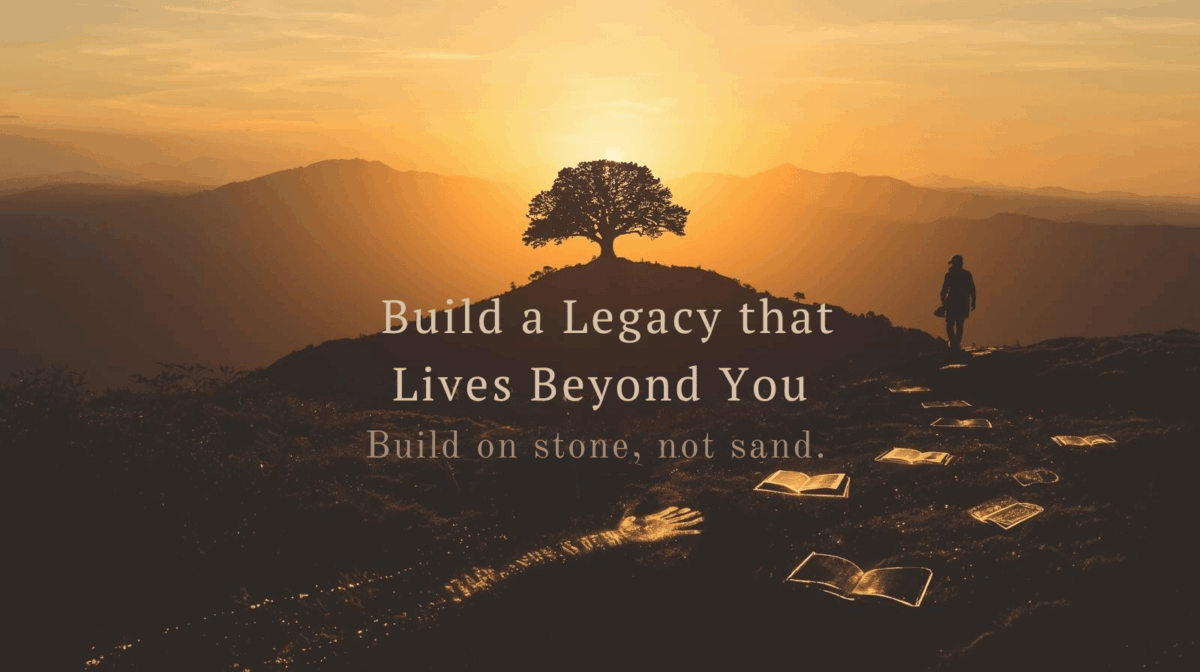
Are You Building a Legacy That Will Outlive You?

“The deeds you do for yourself are gone when you pass away, but the deeds you do for others remain as your legacy.” — Anonymous

We live in a world obsessed with personal gain. Accolades. Awards. Achievements.

But at the end of the road, none of it comes with you.

So I ask you: Are you ashamed to die unless you’ve won some victory for humanity?
That challenge, spoken decades ago by Horace Mann, pierces through time like a call to the soul.

What Are You Really Leaving Behind?

Legacy isn’t about being remembered.
It’s about what you did that keeps living on.
It’s about the fingerprints of love, wisdom, investment, courage, and kindness you leave on other people’s lives.

  • That child you mentored, who now mentors others.
  • That coworker you believed in when no one else did.
  • That idea you planted that sparked a movement.

Legacy is not your name carved in stone—it’s your impact written in hearts.

The Uncomfortable Question

So here’s the mirror moment:

Have you done enough?
Have you poured out enough effort, kindness, love, truth, education, time?

Have you given someone the courage to rise, the tools to grow, or the vision to dream?

Or have you just… existed?

The house you’re building—your legacy—is only as strong as its foundation.
And too many build on sand: money, titles, social media likes.

But what if you chose stone instead?

What Does a Legacy Built on Stone Look Like?

A legacy built on stone is:

  • Consistent: It’s not built in one moment of greatness, but in daily acts of intention.
  • Rooted in service: It’s about others, not you.
  • Scalable: It multiplies—your good becomes someone else’s fuel.
  • Unshakable: When storms come, it doesn’t vanish. It stands tall.

Your Call to Action

I’m not here to inspire you—I’m here to ignite you.
This isn’t about warm fuzzies. It’s about warrior-level purpose.

Here’s your challenge:

What long-lasting impact are you building that will make your community better—even when you’re no longer here?

Stop waiting for the “right moment.” Stop chasing sandcastles.
Start laying stone.

You Don’t Need to Be Famous to Leave a Legacy

You don’t need a million followers.
You need one person… whose life is never the same because of what you did.

Because that becomes a ripple.
And ripples become waves.
And waves shape the world.

Final Word

The question isn’t: Will people remember you?
The real question is:
Will your impact still be working even when your name is forgotten?

Start today.
Build it well.
Build it on stone.

Bonus Challenge: Legacy in 3 Steps

Want a practical start? Try this:

  1. Write down 3 people whose lives you could invest in today.
  2. Ask yourself: What could I give them (time, wisdom, belief, skill) that lasts?
  3. Act before the day ends. Stone doesn’t lay itself.

Don’t Just Read This — Act on It.

If this message spoke to you, don’t keep it to yourself.
📩 Forward it to someone who’s building something that matters.
📲 Share it on your social feed. You never know who needs this today.

And if you’re ready to build something that lasts—
🎤 Book me to speak.
🧭 Invite me to guide your team or community.
💬 Or just connect—I’d love to hear your story.

🔗 LinkedIn: Mark Pinilla
📱 Instagram/Threads: @markthespeaker
📧 Contact: www.markpinilla.com

🧱 Don’t build your legacy on sand.
🔥 Lay stone. Light fires. Leave impact.

Life is a Matchstick

It was a typical Saturday afternoon on the Florida Turnpike. I was headed to an event, catching up with my mother on the phone, checking in on her and my father.

As I drove, I noticed two motorcyclists behind me in the rearview mirror. They were signaling to one another and weaving slightly. In a matter of seconds, they passed me on the ramp onto the 836 eastbound.

Not 20 seconds later, everything changed.

One of the riders was now off his bike, standing and struggling to remove his helmet. His motorcycle was mangled and wedged into the guard rail. A car had stopped behind him to help.

My eyes immediately searched for the second rider. I scanned to the left and saw the second motorcycle — smashed and alone. Then, further left, I saw what I thought might be a body. It looked as if it had been wrapped around the guard rail. My heart dropped.

I hung up on my mother and paused. My mind raced: Call 911. Avoid traffic. Park the car. Go help. Stay safe.

All of this happened in seconds. I knew what to do, but it was like my brain was moving faster than my body.

I called 911.

Thankfully, I have a strong sense of direction. I was able to clearly explain where I was and how emergency services could best access the scene.

The rider near the rail was not moving. The situation was far too graphic to describe in detail. As I waited, a bystander in a Mazda began filming the victim with their phone. I felt indignant. I could not understand how recording such a moment added value to anyone, least of all to the man lying there.

The second rider, the one who had been standing, approached. I gently stopped him.

“Don’t go over there,” I said. “You don’t want that image in your mind.”

I asked for his name.
“Moises N.,” he replied, visibly shaken.

I relayed that to the 911 operator and asked what happened. Moises said his friend had hit something in the road and lost control. Moises could not stop fast enough. He collided with his friend and slid down the ramp after being thrown from his own bike.

When first responders arrived, I flagged them down and gave a brief report. Because I had not witnessed the exact moment of the crash, I was released.

A Day Later: Still Processing

A day later, I cannot stop thinking about Moises. About the unknown rider. About their families. I have prayed for them. I have replayed the moment in my head.

And I keep asking myself, could I have done more?

But in the time it takes to light a match and watch it burn out, a life was lost.

That is how fast it happened. That is how fragile life is.

No second chances.

Moises was left with a second chance. What he does with it is between him and God.

But me? I realize I have one too.

Every day I wake up, I am reminded that I am still here. And that means I still have a chance to live fully, love deeply, and serve intentionally.

Live a Life That Leaves a Legacy

There is a quote I have carried with me for years. It has shaped the way I live and lead:

“Be ashamed to die until you have won some victory for humanity.”
— Horace Mann

I serve my community because I feel like I have a debt to pay.

I have been so blessed. I lack nothing. I want for nothing. And yet I feel like I have not done enough. That if I complain or stop giving, I could lose everything that truly matters.

I never want to lose my humanity. I never want to think, “I have done enough.”

That is why this scripture hits me deeply:

2 Peter 1:5–8 (NIV)
“Make every effort to add to your faith goodness; and to goodness, knowledge; to knowledge, self-control; to self-control, perseverance; to perseverance, godliness; to godliness, mutual affection; and to mutual affection, love. For if you possess these qualities in increasing measure, they will keep you from being ineffective and unproductive  in your knowledge of our Lord Jesus Christ.”

What stands out most to me is this: “In increasing measure.”

That means you never stop. You keep adding. You keep growing. You stay in motion.

NAHREP Discipline #9: Be Generous With People Who Are Less Fortunate

I will keep serving. Not when it is convenient. Not when I feel like it. But because it is how I choose to live.

This is NAHREP Discipline #9:

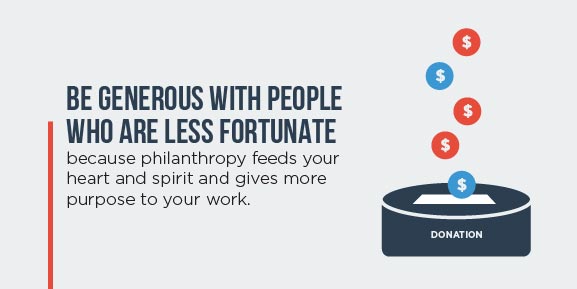
“Be generous with people who are less fortunate because philanthropy feeds your heart and spirit and gives more purpose to your work.”

My legacy is not a destination. My legacy is how I live my life.

“My legacy will be that I served others so they could live a better quality of life and become better versions of themselves — financially, educationally, spiritually, and in their family lives. I hope to inspire them to serve in the same way.”
— Mark Pinilla

🙏 Rest in Peace, unknown motorcyclist.
Your life reminded me that mine still has meaning.
Your tragedy became my moment of clarity.

NBC Article

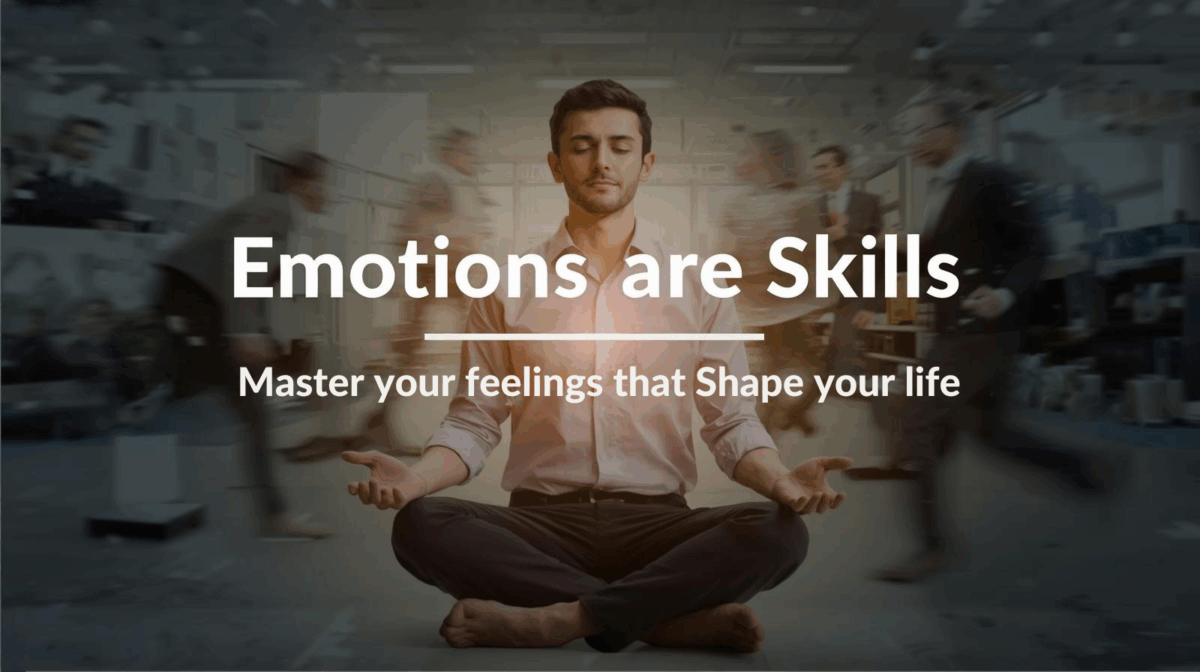
Emotions Are Skills: Master the Feelings That Shape Your Life

Why Emotions Are Skills, Not Traits

Most people treat emotions like the weather. Something that “just happens.”

But emotions aren’t random. They’re not fixed. They’re not personality traits.

Emotions are skills.
You can learn them. Train them. Master them.

Anger, love, fear, joy—these aren’t forces outside you. They’re tools inside you. When you train them, they work for you. When you don’t, they control you.

The difference? Skill.

Emotional Intelligence: The Real Advantage

In today’s world, emotional intelligence (EQ) beats IQ almost every time.

Emotional intelligence isn’t just a “soft skill” — it’s a strategic advantage. Meta-analyses of dozens of studies show that emotional intelligence has a stronger impact on job performance than either IQ or personality traits. In fact, people with higher emotional intelligence tend to perform better, lead more effectively, and build stronger teams. One large-scale study published in Journal of Organizational Behavior found that emotional intelligence accounted for unique variance in performance outcomes, above and beyond cognitive ability or technical skill.

It’s also the #1 predictor of:

  • Job promotions
  • Conflict resolution skills
  • Leadership effectiveness
  • Relationship longevity

Think about it. In high-stress moments, the calmest person wins.
In teams, the most empathetic person connects.
In leadership, the most emotionally skilled person earns trust.

A Personal Story of Emotional Growth

I remember early in my marriage, when my emotional reactions did more damage than good. Raised voices, short tempers, poor control. That wasn’t strength—it was immaturity.

Later, I was presenting at a church camp. While speaking, a glass of water tipped and spilled right onto my laptop. I watched it fall in slow motion.

And yet—I stayed calm.

I instinctively grabbed the laptop, turned it upside down, and kept speaking. No panic. No blame. Just poise.

Same person. Different emotional skill set.

How to Build Emotional Mastery

Let’s get practical. Here are four simple ways to build emotional skills:

1. Name It to Train It

When a strong emotion hits, ask:

What is this? Anger? Anxiety? Shame? Jealousy?

Naming it gives you power over it. It moves you from reaction to reflection.

2. Separate Emotion from Event

Not everything you feel is your fault. One of the most powerful shifts I’ve made is this:

I stopped taking responsibility for what I didn’t cause.

That gives me space to respond—not react.

3. Train the Pause

Emotional mastery often lives in a 3-second pause.
Before you reply. Before you post. Before you yell.

Practice breathing, counting to three, and choosing your tone.

4. Sharpen the Blade

Like any skill, emotions get dull. You need to sharpen them through feedback, reflection, and intentional practice.

Ask:

  • What emotion keeps controlling me?
  • What emotion do I want to show more of—compassion, courage, patience?

That’s your edge.

From Reaction to Legacy

You are not your emotions. You are the trainer of your emotions.

So sharpen your edge. Like a blade, you cut cleaner when you’re sharp.

Whether you’re a father, friend, leader, or partner—mastering your emotions will change how people experience you.

That’s legacy.


Your Challenge Today

  • What emotion keeps hijacking your best moments?
  • What would it look like to train that emotion like a muscle?
  • What would change in your marriage, your leadership, your legacy?

Choose one emotion. Sharpen it. Train it. Own it.


Want Help? Let’s Talk.

If you’re ready to go from good to great emotionally—to lead with clarity, peace, and power—I’d love to help.

Contact Mark Pinilla for one-on-one coaching or team trainings in emotional intelligence, leadership, and legacy-building.

Follow Mark on Instagram: @MarkTheSpeaker

#EmotionalIntelligence, #EmotionalMastery, #SelfAwareness, #PersonalGrowth, and #MasterYourEmotions

Who You Invite to the Table Shapes Your Legacy

I once wrote to a group of powerful women:

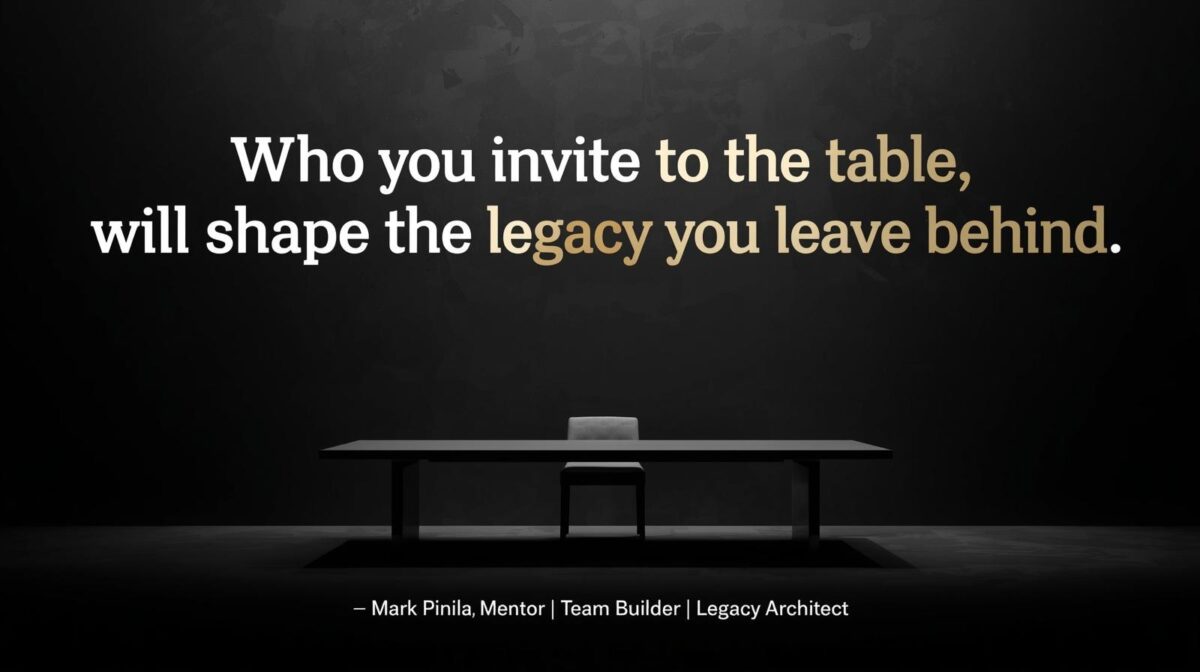
“You are not just building a life—you are building a legacy. And every legacy begins… at a table.”

That message still holds truth. It challenged readers to be intentional with their inner circle. To protect their energy. To choose people who stretch them, sharpen them, and dream even bigger alongside them.

It was a message of discernment—reminding us that not everyone deserves a seat.

But that was only one side of the equation.

Who’s Missing From the Table?

After you clear out distraction, drama, and misalignment, you face a deeper question: Who’s not at the table that should be?

Most of us gather people who reflect our comfort zone. We invite those who look like us, think like us, and affirm our ideas. While this feels natural, it limits our growth.

More importantly, it often causes us to miss the voices that would complete our vision.

Legacy Requires Both Energies

Let’s talk about what most tables are missing: balance.

In particular, we need to blend testosterone and estrogen—not just in gender, but in energy and approach.

Testosterone brings drive, direction, and execution. It accelerates movement.

Estrogen offers insight, emotional intelligence, and relational depth. It strengthens the foundation.

When testosterone dominates, things move fast—but may burn out. When estrogen stands alone, things feel grounded—but may hesitate to scale.

However, when these forces collaborate, we get both momentum and meaning. We create the chemistry that fuels legacy.

A Challenge to Men

If every voice at your table sounds like yours, you’re not leading a team—you’re stuck in an echo chamber.

And echo chambers don’t evolve. They collapse.

You need women at the table. Not to check a box, but because they bring depth you cannot create on your own. They elevate strategy with empathy. They turn movement into meaning.

Their presence isn’t a liability. It’s an advantage.

A Challenge to Women

You’ve already shown you can lead, execute, and rise.

Still, legacy isn’t built in isolation. Collaboration doesn’t diminish your brilliance—it amplifies it.

Yes, surround yourself with strong women. But also make space for men who see your strength, support your vision, and collaborate without controlling.

You’re not waiting for permission. But sometimes, you are waiting for alignment. And that requires courageous connection.

Reframing My Original Message

In my original writing, I said:

“No one comes to my table who does not add value to my life.”

That still stands.

This was always clear to me—but it wasn’t the point I was making then. That message was about protecting your space. This one is about expanding it.

Because value doesn’t always announce itself. Sometimes it walks in quietly. Sometimes it challenges you. And sometimes, it looks nothing like what you expected—but it changes everything.

A great team is made up of people who challenge, not just compliment.

They shift your perspective, question your assumptions, and make you better—not just busier.

Build With Intention, Not Comfort

You don’t rise to the level of your goals.
You fall to the level of your circle.

That’s why I intentionally include women at my table. Women who challenge with clarity, who sharpen with wisdom, who don’t just speak—but speak into what we’re building.

With them, it’s not about dominance or control. It’s about collaboration and creation.

Legacy isn’t built in echo chambers. It’s built in tension, trust, and truth.

Let’s Build Something That Lasts

If you’re ready to build that kind of table—not just to grow, but to grow with purpose—this is the work I do every day.

As a speaker, mentor, and trainer, I help individuals and organizations build teams rooted in values, vision, and legacy. Because success that stands alone fades. But success that lifts others with it? That becomes legacy.

Whether I’m coaching on intentional leadership, facilitating team development, or walking leaders through the NAHREP 10 Disciplines, my mission stays the same:

To help you build a life, a business, and a team that lasts.

You don’t need more noise.
You need alignment.
You need people who stretch your capacity, not drain it.
You need a circle that reflects your future—not your past.

That’s legacy work. And that’s what I do.

Learn more at www.markpinilla.com
Connect with me on LinkedIn: linkedin.com/in/markpinilla
Follow my journey on Instagram: @markpinilla

Let’s build the kind of team—and table—that shapes generations.