
Manifestation Rewires Your Brain for Success

Manifestation rewires your brain for success, whether you realize it or not. The stories you repeat in your mind shape your beliefs, your decisions, and ultimately the direction of your life.

Inspiration comes in many forms.

Today, mine came from my daughter, through a tattoo.

I’ve never been one for tattoos. I can appreciate the art, but it’s simply not something I would ever do myself. This isn’t about right or wrong. It’s about meaning.

Her new ink reads: “We Chase Misprinted Lies.”

When I asked her what it meant, she said, “We make up stories in our heads about how things are, and those stories keep us from being true to ourselves.”

That stopped me.

The phrase, taken from the Alice in Chains song Nutshell, is commonly interpreted as a reflection of our tendency to chase false beliefs and distorted truths.

And that is exactly where manifestation begins.

Your Mind Is the First Battlefield

Manifestation does not begin in the physical world. It begins in the mind.

Neuroscience shows that the brain responds to repetition, imagery, and emotional association. These inputs form patterns. Patterns become habits. Habits become outcomes.

Change the pattern, and the outcome follows.

As Em on the Brain puts it:
“Reality does not exist in the physical world—it exists in your mind. So when you’re manifesting, what you’re doing is trying to change your mental reality. AKA rewire your brain, so in order to manifest the things you want…”

This isn’t magic. It’s neuroplasticity. You’re not bending reality—you’re bending your beliefs, your focus, and your behaviors into alignment with what you want.

How Manifestation Rewires Your Brain for Success

Manifestation is not wishful thinking. It is structured mental conditioning.

Here are three practical routines that help rewire the brain for success.

1. Visualization Habits That Program the Mind for Action

Visualization has been shown to improve performance by more than 20 percent. People who vividly picture their goals are significantly more likely to achieve them.

The key is to visualize the process, not just the result.

See yourself walking across the graduation stage.
Defending your first case.
Signing the contract.
Driving the car.
Stepping into the role.

Your brain prepares for action through repetition, whether imagined or real.

You are not meant to be a bystander in your own story.
You are meant to be the writer, the producer, and the director of your life’s movie.

2. Scripting Your Future Into Present Reality

Writing shapes belief.

When you write your goals as if they already exist, you align identity with intention.

Common methods include:

  • Writing the same goal 55 times for 5 days
  • Writing goals three times in the morning, six in the afternoon, and nine at night
  • Gratitude journaling written in the present tense

Clarity plus repetition builds belief.

3. Rewiring the Brain Through Your Environment

Your environment is constantly programming your mind.

What you listen to, who you surround yourself with, and what you consume repeatedly shape your internal dialogue.

Choose inputs that support growth.
Reduce exposure to negativity.
Spend time with people who challenge you to be better.

Your mind believes what it hears most often.

Manifestation Rewires Your Brain—Now Live It Out

Most people are living out scripts they never consciously chose.

But you don’t have to keep reading from the same page.
You can pause. You can rewrite the story.
Most importantly, you can take full control—starting now.

Speak new truth.
Visualize the process.
Script your success.
Rewire your thinking.
And take ownership of your story.

Next Steps on Your Journey

If this message resonated, it may be time to go deeper.

Mark Pinilla is a Certified NAHREP 10 trainer who helps individuals and families align mindset, money habits, and long-term direction.

Learn more at:
https://www.markpinilla.com

Connect with Mark:
Follow me on 📸 Instagram, 💼 LinkedIn, and 📍 Google Business

You don’t have to have everything figured out.
But you do have to begin.

Better Isn’t Always Best: How to Know What’s Right for You

There comes a point in life when experience becomes your sharpest filter. At 50, I’ve learned that better isn’t always best. Just because something feels improved doesn’t mean it’s right for you—or good for your future.

In the days of old Gran Colombia, a region that once included Venezuela, Colombia, and Ecuador, there was a well-known phrase:

“La ley se acata pero no se cumple.”
The law is obeyed, but not fulfilled.

People acknowledged the law but often ignored it. They heard it, but they did not live by it. Sometimes this was rebellion. Other times it was survival. In many cases, it was wisdom earned through experience.

I saw this firsthand in South America, where people would run red lights late at night. Not because they were reckless, but because stopping made them vulnerable to robbery or worse. In moments like that, strict obedience could cost you your safety. Context mattered.

This same principle applies far beyond laws.

A Real Story from Ecuador

I lived in Ecuador for a year as part of a study abroad program with students from Oregon. One student stood out. We’ll call her Julie. She was blonde, bubbly, and visibly different from most of the local population.

Julie met a local man who was charming, attentive, and charismatic. Before long, marriage was on the table.

I asked her why she felt so certain.

“He is so much better than my ex,” she said.

Her ex had been physically and verbally abusive. And that was the problem.

Pain had become her point of reference.

Better than your worst does not mean best for your future.

I shared my perspective carefully. I explained that comparing a new relationship to trauma sets the bar dangerously low. Julie deserved more than “not abusive.” She deserved what was right for her long-term growth.

In the end, she made her decision.

They married, moved back to the United States, had a child, and later divorced.

I’m not telling this story to say I was right. I’m sharing it because too often we confuse comfort for clarity and relief for alignment.

Why “Better Isn’t Always Best” in Everyday Life

We all do it.

We compare ourselves to the wealthier person.
There’s the new car, the vacation photos, the growing follower count.
What we don’t see is what’s behind the filter.

Some of the same influencers we admire are breaking down, going broke, or silently drowning in pressure. We see the success, not the sacrifice. The surface, not the cost.

But the truth is, better isn’t always best. Especially when the choice is based on shallow comparisons, past pain, or fear of being alone. We chase progress by looking backward, and that rarely leads to alignment. The appearance of improvement doesn’t guarantee the reality of it.

This is why filtering advice and measuring growth requires clarity—not comparison.

Advice Is Not Truth Until It Is Filtered

As a father, I give advice to my young adult children. I also understand that advice only works when it is chosen, not forced.

The same is true for all of us.

Advice must be filtered.

You must decide if what sounds better is actually right, because better isn’t always best, even when it’s popular advice. What feels good isn’t always what builds you. What feels familiar isn’t always what frees you.

Here’s how to filter what you hear:

  1. Does this advice align with your values, or someone else’s fears?
  2. Does it enrich your life, or simply sound comforting?
  3. Can you trace real results from this advice, or is it just theory?

Good advice is not always pleasant. But it is always constructive.

Your Challenge

Pause before your next decision.

Consider whether you’re choosing from your future or reacting to your past. Are you trying to impress—or to progress? And is the option in front of you truly right, or just better than something that once hurt you?

Better can still be wrong. It is just more comfortable.

Final Thought: Better Isn’t Always Best in the End

Success is not about choosing what looks better.
It is about choosing what is right for you and having the courage to live with that choice.

In the end, better isn’t always best. What matters is what aligns with your future, your values, and your long-term purpose. Choosing what feels familiar or looks safer can keep you trapped in the same cycles you’re trying to grow beyond.

Your life is not built through comparison.
It is built through conviction.

CALL TO ACTION

To explore more insights on growth, clarity, wealth, and legacy, or to discuss how these strategies apply to your life or business, contact Mark Pinilla directly.

🌐 MarkPinilla.com
📍 Google Business Page
📘 The 10 Disciplines
💼LinkedIn

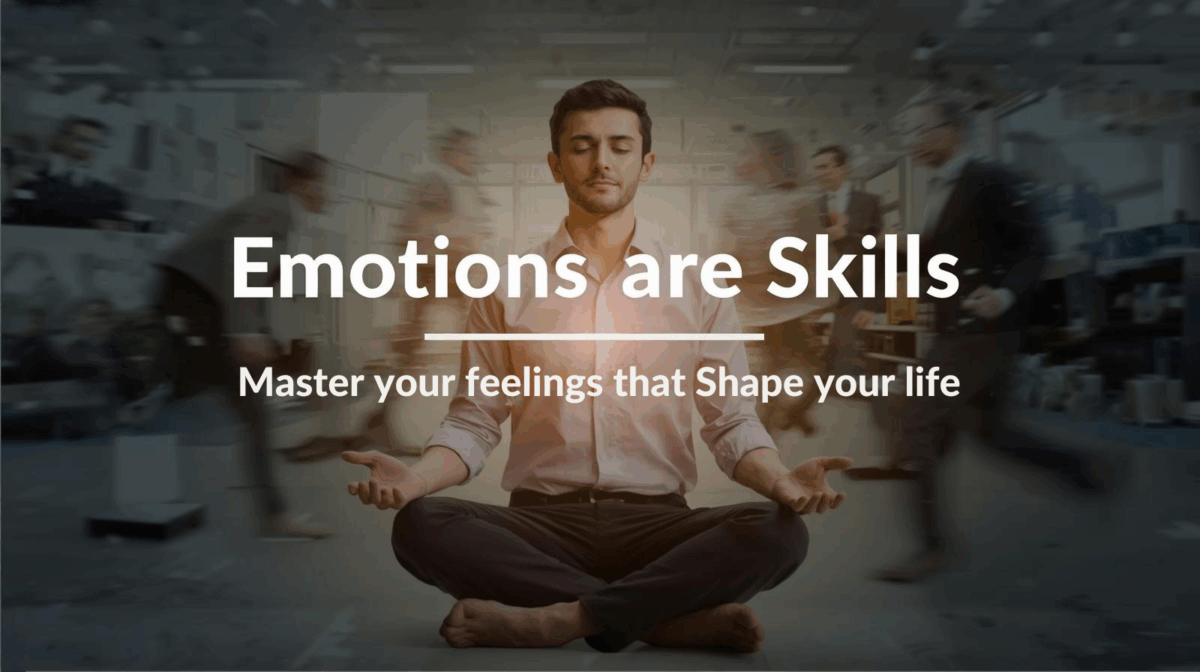
Emotions Are Skills: Master the Feelings That Shape Your Life

Why Emotions Are Skills, Not Traits

Most people treat emotions like the weather. Something that “just happens.”

But emotions aren’t random. They’re not fixed. They’re not personality traits.

Emotions are skills.
You can learn them. Train them. Master them.

Anger, love, fear, joy—these aren’t forces outside you. They’re tools inside you. When you train them, they work for you. When you don’t, they control you.

The difference? Skill.

Emotional Intelligence: The Real Advantage

In today’s world, emotional intelligence (EQ) beats IQ almost every time.

Emotional intelligence isn’t just a “soft skill” — it’s a strategic advantage. Meta-analyses of dozens of studies show that emotional intelligence has a stronger impact on job performance than either IQ or personality traits. In fact, people with higher emotional intelligence tend to perform better, lead more effectively, and build stronger teams. One large-scale study published in Journal of Organizational Behavior found that emotional intelligence accounted for unique variance in performance outcomes, above and beyond cognitive ability or technical skill.

It’s also the #1 predictor of:

  • Job promotions
  • Conflict resolution skills
  • Leadership effectiveness
  • Relationship longevity

Think about it. In high-stress moments, the calmest person wins.
In teams, the most empathetic person connects.
In leadership, the most emotionally skilled person earns trust.

A Personal Story of Emotional Growth

I remember early in my marriage, when my emotional reactions did more damage than good. Raised voices, short tempers, poor control. That wasn’t strength—it was immaturity.

Later, I was presenting at a church camp. While speaking, a glass of water tipped and spilled right onto my laptop. I watched it fall in slow motion.

And yet—I stayed calm.

I instinctively grabbed the laptop, turned it upside down, and kept speaking. No panic. No blame. Just poise.

Same person. Different emotional skill set.

How to Build Emotional Mastery

Let’s get practical. Here are four simple ways to build emotional skills:

1. Name It to Train It

When a strong emotion hits, ask:

What is this? Anger? Anxiety? Shame? Jealousy?

Naming it gives you power over it. It moves you from reaction to reflection.

2. Separate Emotion from Event

Not everything you feel is your fault. One of the most powerful shifts I’ve made is this:

I stopped taking responsibility for what I didn’t cause.

That gives me space to respond—not react.

3. Train the Pause

Emotional mastery often lives in a 3-second pause.
Before you reply. Before you post. Before you yell.

Practice breathing, counting to three, and choosing your tone.

4. Sharpen the Blade

Like any skill, emotions get dull. You need to sharpen them through feedback, reflection, and intentional practice.

Ask:

  • What emotion keeps controlling me?
  • What emotion do I want to show more of—compassion, courage, patience?

That’s your edge.

From Reaction to Legacy

You are not your emotions. You are the trainer of your emotions.

So sharpen your edge. Like a blade, you cut cleaner when you’re sharp.

Whether you’re a father, friend, leader, or partner—mastering your emotions will change how people experience you.

That’s legacy.


Your Challenge Today

  • What emotion keeps hijacking your best moments?
  • What would it look like to train that emotion like a muscle?
  • What would change in your marriage, your leadership, your legacy?

Choose one emotion. Sharpen it. Train it. Own it.


Want Help? Let’s Talk.

If you’re ready to go from good to great emotionally—to lead with clarity, peace, and power—I’d love to help.

Contact Mark Pinilla for one-on-one coaching or team trainings in emotional intelligence, leadership, and legacy-building.

Follow Mark on Instagram: @MarkTheSpeaker

#EmotionalIntelligence, #EmotionalMastery, #SelfAwareness, #PersonalGrowth, and #MasterYourEmotions

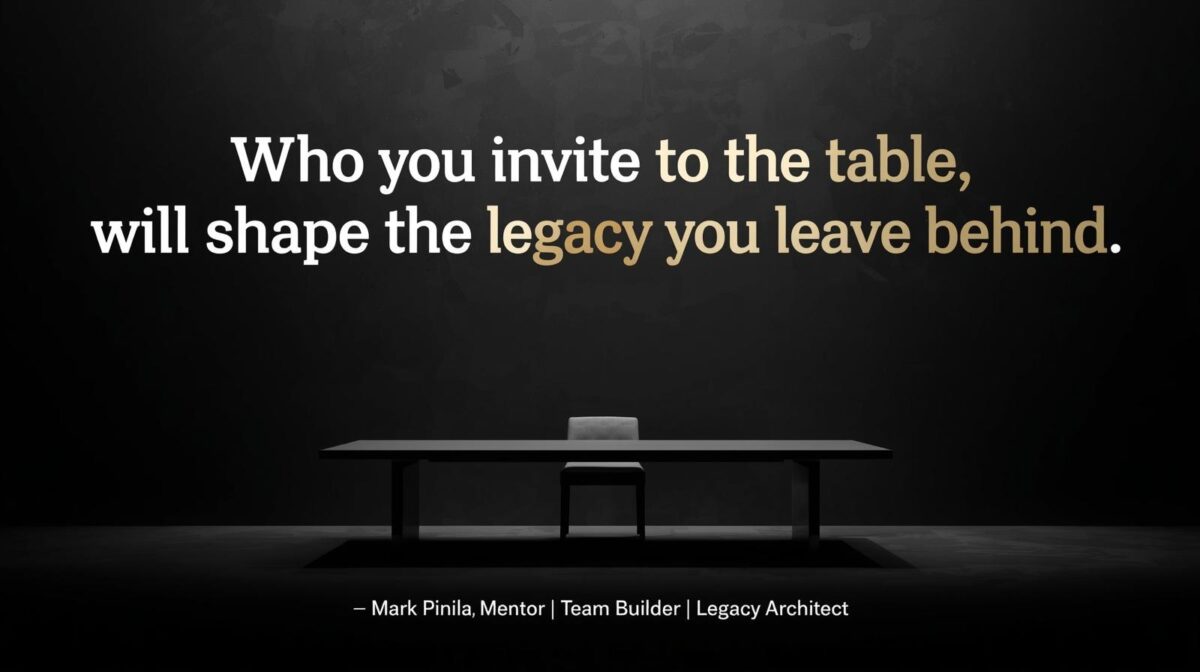
Who You Invite to the Table Shapes Your Legacy

I once wrote to a group of powerful women:

“You are not just building a life—you are building a legacy. And every legacy begins… at a table.”

That message still holds truth. It challenged readers to be intentional with their inner circle. To protect their energy. To choose people who stretch them, sharpen them, and dream even bigger alongside them.

It was a message of discernment—reminding us that not everyone deserves a seat.

But that was only one side of the equation.

Who’s Missing From the Table?

After you clear out distraction, drama, and misalignment, you face a deeper question: Who’s not at the table that should be?

Most of us gather people who reflect our comfort zone. We invite those who look like us, think like us, and affirm our ideas. While this feels natural, it limits our growth.

More importantly, it often causes us to miss the voices that would complete our vision.

Legacy Requires Both Energies

Let’s talk about what most tables are missing: balance.

In particular, we need to blend testosterone and estrogen—not just in gender, but in energy and approach.

Testosterone brings drive, direction, and execution. It accelerates movement.

Estrogen offers insight, emotional intelligence, and relational depth. It strengthens the foundation.

When testosterone dominates, things move fast—but may burn out. When estrogen stands alone, things feel grounded—but may hesitate to scale.

However, when these forces collaborate, we get both momentum and meaning. We create the chemistry that fuels legacy.

A Challenge to Men

If every voice at your table sounds like yours, you’re not leading a team—you’re stuck in an echo chamber.

And echo chambers don’t evolve. They collapse.

You need women at the table. Not to check a box, but because they bring depth you cannot create on your own. They elevate strategy with empathy. They turn movement into meaning.

Their presence isn’t a liability. It’s an advantage.

A Challenge to Women

You’ve already shown you can lead, execute, and rise.

Still, legacy isn’t built in isolation. Collaboration doesn’t diminish your brilliance—it amplifies it.

Yes, surround yourself with strong women. But also make space for men who see your strength, support your vision, and collaborate without controlling.

You’re not waiting for permission. But sometimes, you are waiting for alignment. And that requires courageous connection.

Reframing My Original Message

In my original writing, I said:

“No one comes to my table who does not add value to my life.”

That still stands.

This was always clear to me—but it wasn’t the point I was making then. That message was about protecting your space. This one is about expanding it.

Because value doesn’t always announce itself. Sometimes it walks in quietly. Sometimes it challenges you. And sometimes, it looks nothing like what you expected—but it changes everything.

A great team is made up of people who challenge, not just compliment.

They shift your perspective, question your assumptions, and make you better—not just busier.

Build With Intention, Not Comfort

You don’t rise to the level of your goals.
You fall to the level of your circle.

That’s why I intentionally include women at my table. Women who challenge with clarity, who sharpen with wisdom, who don’t just speak—but speak into what we’re building.

With them, it’s not about dominance or control. It’s about collaboration and creation.

Legacy isn’t built in echo chambers. It’s built in tension, trust, and truth.

Let’s Build Something That Lasts

If you’re ready to build that kind of table—not just to grow, but to grow with purpose—this is the work I do every day.

As a speaker, mentor, and trainer, I help individuals and organizations build teams rooted in values, vision, and legacy. Because success that stands alone fades. But success that lifts others with it? That becomes legacy.

Whether I’m coaching on intentional leadership, facilitating team development, or walking leaders through the NAHREP 10 Disciplines, my mission stays the same:

To help you build a life, a business, and a team that lasts.

You don’t need more noise.
You need alignment.
You need people who stretch your capacity, not drain it.
You need a circle that reflects your future—not your past.

That’s legacy work. And that’s what I do.

Learn more at www.markpinilla.com
Connect with me on LinkedIn: linkedin.com/in/markpinilla
Follow my journey on Instagram: @markpinilla

Let’s build the kind of team—and table—that shapes generations.

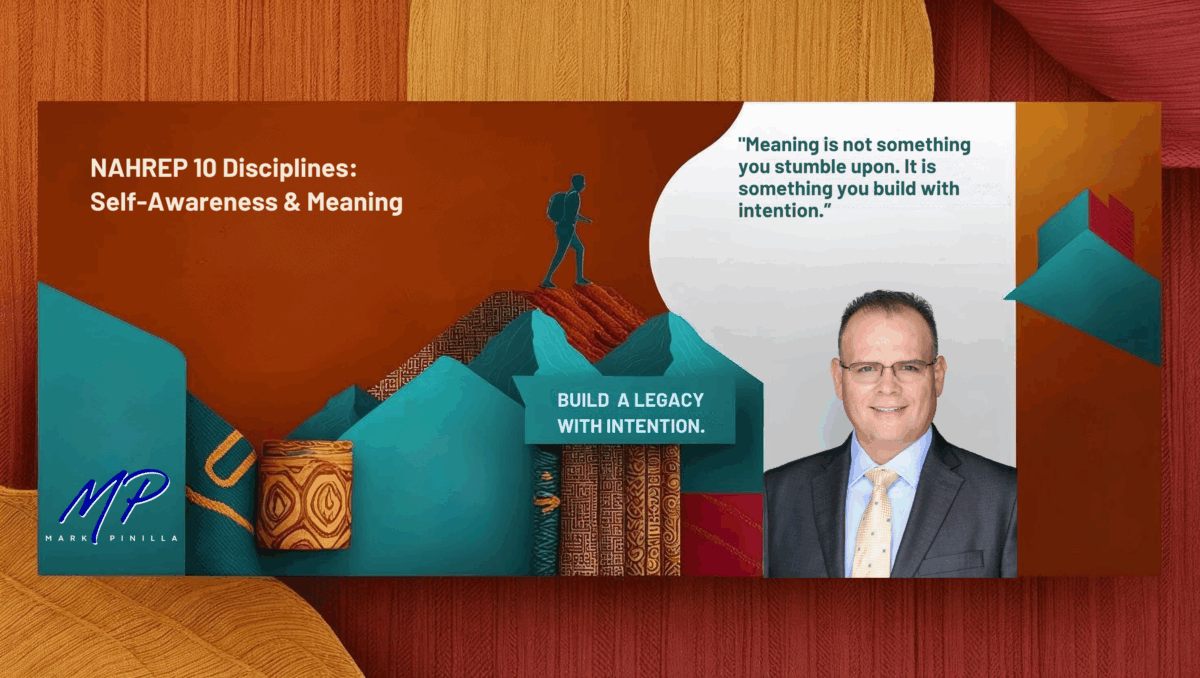
NAHREP 10 Disciplines: Self-Awareness & Meaning

In a time when achievement is often mistaken for fulfillment, the question of what gives life true meaning has never been more urgent. Many chase success but feel no satisfaction. They build wealth but lack peace. As someone who trains and coaches others using the NAHREP 10 Disciplines, I have seen firsthand that meaning is not found in accolades or approval. It is created through alignment, action, and accountability.

Meaning is not something you stumble upon. It is something you build with intention. And the foundation is discipline.

Simon Sinek teaches us to start with why. John Maxwell reminds us that leadership is influence. Brene Brown urges us to lead with vulnerability and integrity. These principles, echoed in the NAHREP 10 Disciplines, point us toward a powerful truth. When you align your daily actions with your highest values, your life becomes meaningful because it begins to matter to others.

As a NAHREP 10 Certified Trainer, my mission is to help professionals grow their impact by living with intention. Whether you are building a real estate business, creating financial freedom, or becoming a role model in your community, the lessons are the same. Be honest with yourself, stay disciplined in your habits, and lead with vision, as highlighted by the NAHREP 10 Disciplines.

Self-Awareness of your Financial Position

Every step toward lasting growth begins with one critical act: telling yourself the truth. Not sugarcoating. Not avoiding. Just getting real. This isn’t about guilt—it’s about ownership. Because when you clearly see where you stand, you finally have the power to change it.

One of the most transformational financial habits is knowing your net worth. It’s not just a number—it’s a mirror. It reflects how you’ve handled money, what habits you’ve built, and where your priorities lie. Tracking your net worth forces you to face the truth: what you own, what you owe, and what direction you’re actually heading in.

When you do the math, you stop guessing—and start growing. Because awareness leads to smarter decisions, and smarter decisions lead to financial freedom. That’s why this NAHREP 10 Discipline isn’t optional. It’s foundational within the NAHREP 10 Disciplines framework.

Mastery and Growth is a Core Value

A life without skill is a life without direction. As professionals, we must commit to being excellent at what we do. That means becoming a student of our craft. It means reading, training, practicing, and sharpening our thinking every single day.

Clarity in language and confidence in communication are more than soft skills. They are tools of influence. Whether in a client consultation or a family conversation, those who can speak clearly, listen actively, and write with purpose are those who lead with impact.

Being coachable is one of the most underrated disciplines. It is not about admitting weakness. It is about welcoming growth. A willingness to learn from others and evolve your mindset is how you stay relevant and resilient, as highlighted by NAHREP 10 Disciplines.

The Climb to Success: Discipline and the NAHREP Path to Impact

No worthwhile goal comes without resistance. The best leaders are not those who had it easy. They are those who chose to keep climbing when things got hard. If you want to be in the top 10 percent of your profession, you need to train for it like an athlete. Not just with more effort, but with more intention.

Success is not about working more hours. It is about doing the right work with the right mindset, for the right reasons. When your purpose is clear, your energy has direction. When your goals have depth, your discipline becomes sustainable. Aligning with the NAHREP 10 Disciplines makes this journey easier.

Civic Engagement and Advocating with Purpose

One of the most important but often overlooked aspects of building a meaningful life is the ability to impact change beyond your immediate circle. True leadership includes understanding how laws, policies, and government systems affect your business, your community, and future generations.

Being politically savvy means staying informed about public policy, engaging with your local representatives, and using your voice to advocate for the interests of underserved communities. It is not about partisanship or political theater. It is about responsible citizenship and strategic involvement in the systems that shape opportunity.

The NAHREP 10 Disciplines challenge us to use our influence not just for profit, but for progress. Whether you are supporting housing legislation, advocating for fair lending, or encouraging civic participation, your engagement matters. Change does not happen by chance. It happens when prepared leaders show up.

Call to Action

Now is the time to begin. Whether you are reflecting on your finances, your leadership, or your community impact, the shift starts with one decision—to become more intentional, more informed, and more aligned. You have the power to begin that change today.

If you are ready to lead a life that is not just successful but significant, reach out. I would be honored to support your growth, your business, and your role in creating generational wealth within your community. Whether through a strategy session, a training workshop, or simply a meaningful conversation, let’s move forward together.

Contact Mark Pinilla to explore how the NAHREP 10 Disciplines can help you grow, give back, and lead with impact.

#LiveWithPurpose #MeaningfulLeadership #NAHREP10 #LatinoLeadership #GenerationalWealth #BuildWithDiscipline #PolicyWithPurpose #EmpowerYAvanza #RealEstateImpact #CommunityDrivenSuccess #MarkPinilla #PurposeInAction #AdvocateForChange #LeadershipDevelopment #LegacyBuilders #HispanicWealthProject #NAHREP #NAHREPSouthFlorida

Dan Nziniga – Living the NAHREP Discipline #10

Living the NAHREP 10 Disciplines
Dan Nziniga

Dan Nziniga

Dreamworks – Inspiration Community Owner & Leader Dan Nzinga is being recognized for living Discipline #10.

Blood Isn’t Always Thicker Than Water: The Power of Chosen Family

They say that blood is thicker than water, but sometimes, there is no blood bond around. As a college student studying abroad, I found myself in a foreign country with no family by my side. My host family, though not related by blood, welcomed me with open arms. Almost instantly, I became a brother and an uncle, embraced as one of their own. Now, more than thirty years later, I am still called “uncle” and “brother,” a testament to the deep, unbreakable bonds we forged.

This experience embodies NAHREP’s 10 Disciplines, specifically Discipline #10: Be Active in the Lives of Your Family and Children (Learn more), because Familia is central to who we are. But family is not always defined by genetics—it’s defined by love, support, and shared experiences.

I see the same spirit reflected in Dan Nzinga and the community he has built. Through 21-day challenges, weekly Zoom calls, and constant mentorship, Dan has created his own family of coaches, trainers, and leaders who support one another in their personal and professional growth. He doesn’t just teach—he cares, guides, and inspires. His leadership has cultivated a self-made family that rallies around him and uplifts those who follow his path.

Every day, Dan delivers a dose of positivity and growth, reminding us that our true family isn’t always the one we’re born into—it’s the one we choose, the one that chooses us, and the one that pushes us to become better versions of ourselves.

Well done, Dan! Keep inspiring and leading your extended family to greatness.

Connect with Dan Nzinga: LinkedIn

#ChosenFamily #SupportSystem #NAHREP #DanNzinga #FamilyMatters #Mentorship #Inspiration

You Can’t Control Everything, But You Can Control Your Response

Life has a way of humbling us. One moment, everything is going smoothly, and the next, you’re hit with an unexpected challenge—a job loss, a heartbreak, a health crisis. We scramble, trying to regain control, but here’s the truth: You don’t control the storm. You only control how you sail through it.

John C. Maxwell says, “Life is 10% what happens to you and 90% how you react to it.” Eric Thomas tells us that pain is temporary but quitting lasts forever. So, if we can’t dictate every outcome, how do we shift our energy toward winning despite the chaos?

1. Control Your Mindset

Your thoughts dictate your actions, and your actions shape your future. When you face obstacles, you have two choices: Let them defeat you or use them as fuel to push forward. Instead of saying, “Why me?” start asking, “What can I learn from this?” This mental shift transforms pain into power.

Exercise:

Every morning, practice gratitude. Write down three things you’re grateful for. This rewires your brain to focus on abundance instead of lack.

2. Adapt, Don’t Resist

Resistance leads to suffering. The more we fight what we can’t control, the more exhausted we become. Instead, embrace adaptability. Like water, flow around obstacles instead of smashing into them. Life doesn’t stop moving, and neither should you.

Action Step:

Identify one thing in your life you’ve been resisting and find a way to embrace it. Instead of fearing change, ask yourself, “How can this make me stronger?”

3. Channel Your Energy into What Matters

Worry drains energy. Fear paralyzes. Instead of obsessing over what you can’t change, shift your focus to things you can influence. Can’t control the economy? Master your financial discipline. Can’t control other people? Master your reactions. Your energy is a currency—spend it wisely.

Quick Hack:

List three things you can control today and take action on them. Small wins create unstoppable momentum.

4. Surround Yourself with Resilient People

Energy is contagious. If you surround yourself with complainers, you’ll become one. But if you align yourself with warriors—people who push forward despite adversity—you’ll rise with them.

Challenge:

Audit your circle. Who inspires you? Who drains you? Adjust accordingly. Choose to walk with winners.

5. Give More Than You Take

When life feels unfair, the best way to reclaim your power is by giving. Acts of kindness shift your focus from lack to abundance. Serve others, and you’ll find renewed purpose in your own struggles.

Mission:

Perform one selfless act today. Whether it’s a kind word, a donation, or a helping hand, put positive energy into the world.

Your Call to Action: Rise Up!

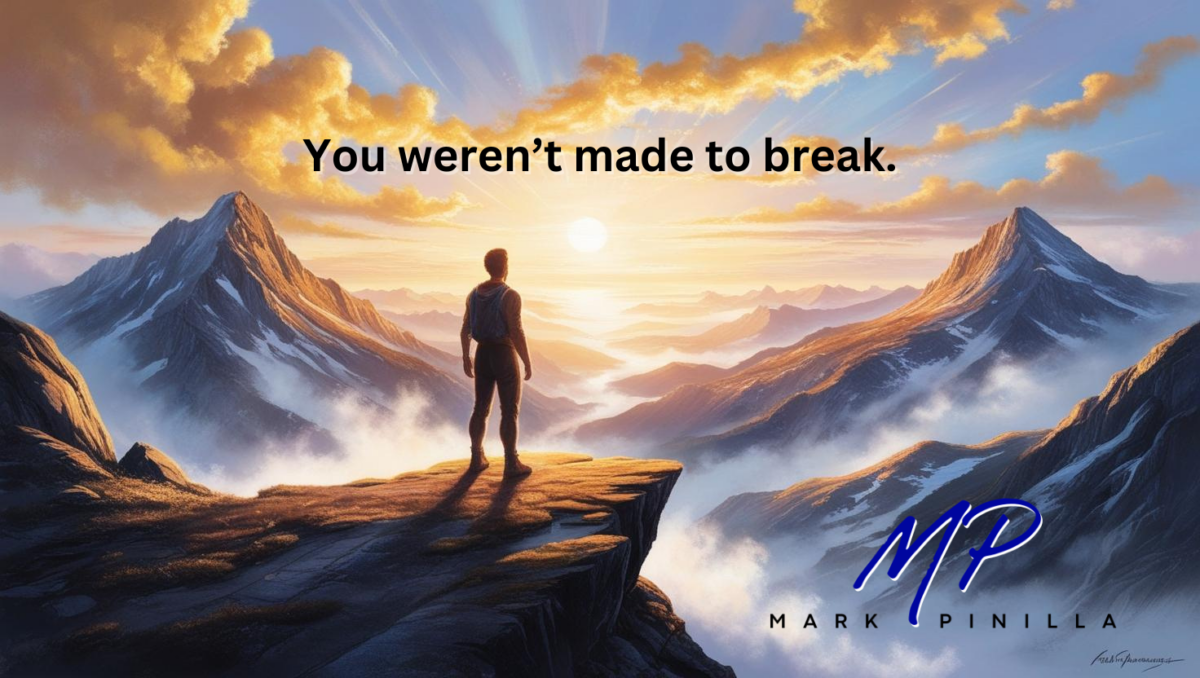
You weren’t made to break. Life is testing you not to destroy you, but to make you stronger. Refuse to be a victim. Choose to be a fighter. Embrace challenges, adapt, and thrive. Because at the end of the day, the ones who succeed aren’t the ones who control everything. They’re the ones who master themselves.

Are you ready to turn obstacles into opportunities? Start today. Share this with someone who needs to hear it.

#KeepPushing #MindsetMatters #TurnPainIntoPower #StrongerThanYesterday #YouGotThis #MarkPinilla