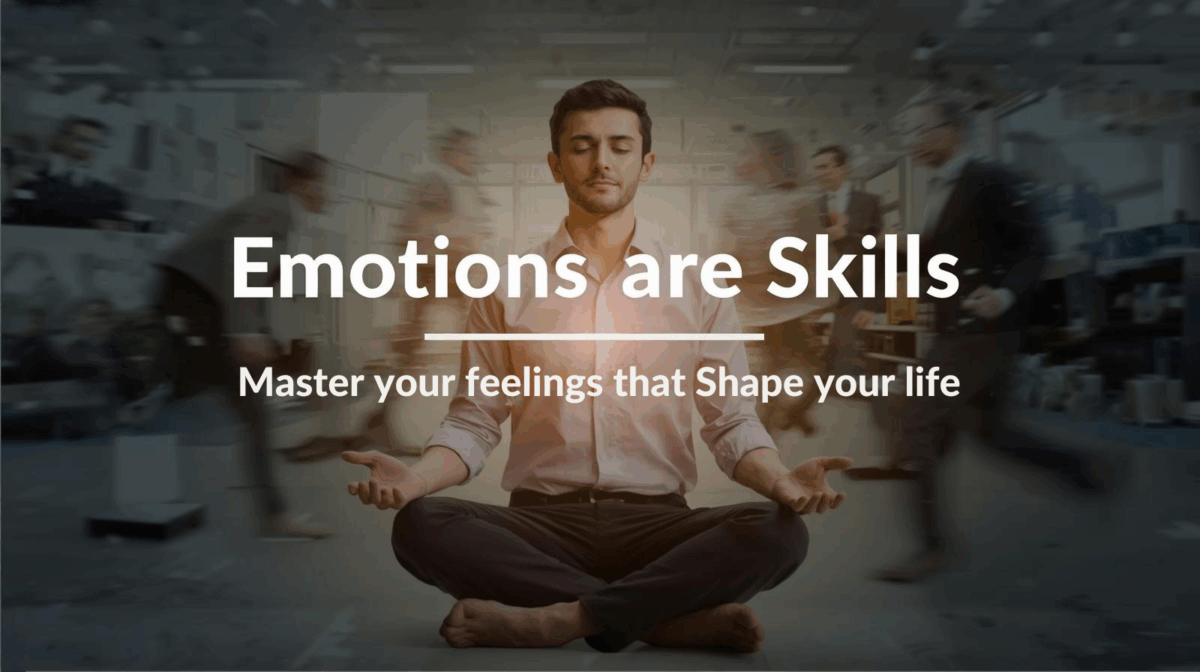
Why Emotions Are Skills, Not Traits
Most people treat emotions like the weather. Something that “just happens.”
But emotions aren’t random. They’re not fixed. They’re not personality traits.
Emotions are skills.
You can learn them. Train them. Master them.
Anger, love, fear, joy—these aren’t forces outside you. They’re tools inside you. When you train them, they work for you. When you don’t, they control you.
The difference? Skill.
Emotional Intelligence: The Real Advantage
In today’s world, emotional intelligence (EQ) beats IQ almost every time.
Emotional intelligence isn’t just a “soft skill” — it’s a strategic advantage. Meta-analyses of dozens of studies show that emotional intelligence has a stronger impact on job performance than either IQ or personality traits. In fact, people with higher emotional intelligence tend to perform better, lead more effectively, and build stronger teams. One large-scale study published in Journal of Organizational Behavior found that emotional intelligence accounted for unique variance in performance outcomes, above and beyond cognitive ability or technical skill.
It’s also the #1 predictor of:
- Job promotions
- Conflict resolution skills
- Leadership effectiveness
- Relationship longevity
Think about it. In high-stress moments, the calmest person wins.
In teams, the most empathetic person connects.
In leadership, the most emotionally skilled person earns trust.
A Personal Story of Emotional Growth
I remember early in my marriage, when my emotional reactions did more damage than good. Raised voices, short tempers, poor control. That wasn’t strength—it was immaturity.
Later, I was presenting at a church camp. While speaking, a glass of water tipped and spilled right onto my laptop. I watched it fall in slow motion.
And yet—I stayed calm.
I instinctively grabbed the laptop, turned it upside down, and kept speaking. No panic. No blame. Just poise.
Same person. Different emotional skill set.
How to Build Emotional Mastery
Let’s get practical. Here are four simple ways to build emotional skills:
1. Name It to Train It
When a strong emotion hits, ask:
What is this? Anger? Anxiety? Shame? Jealousy?
Naming it gives you power over it. It moves you from reaction to reflection.
2. Separate Emotion from Event
Not everything you feel is your fault. One of the most powerful shifts I’ve made is this:
I stopped taking responsibility for what I didn’t cause.
That gives me space to respond—not react.
3. Train the Pause
Emotional mastery often lives in a 3-second pause.
Before you reply. Before you post. Before you yell.
Practice breathing, counting to three, and choosing your tone.
4. Sharpen the Blade
Like any skill, emotions get dull. You need to sharpen them through feedback, reflection, and intentional practice.
Ask:
- What emotion keeps controlling me?
- What emotion do I want to show more of—compassion, courage, patience?
That’s your edge.
From Reaction to Legacy
You are not your emotions. You are the trainer of your emotions.
So sharpen your edge. Like a blade, you cut cleaner when you’re sharp.
Whether you’re a father, friend, leader, or partner—mastering your emotions will change how people experience you.
That’s legacy.
Your Challenge Today
- What emotion keeps hijacking your best moments?
- What would it look like to train that emotion like a muscle?
- What would change in your marriage, your leadership, your legacy?
Choose one emotion. Sharpen it. Train it. Own it.
Want Help? Let’s Talk.
If you’re ready to go from good to great emotionally—to lead with clarity, peace, and power—I’d love to help.
Contact Mark Pinilla for one-on-one coaching or team trainings in emotional intelligence, leadership, and legacy-building.
Follow Mark on Instagram: @MarkTheSpeaker
#EmotionalIntelligence, #EmotionalMastery, #SelfAwareness, #PersonalGrowth, and #MasterYourEmotions